
Grace Notes · The Complete Doctrine Series
How God Speaks
to Broken People
HOW GOD SPEAKS TO BROKEN PEOPLE · GENERAL & SPECIAL REVELATION
Four volumes. Four doctrines. One foundation for anyone who needs to know if the Bible can be trusted — and why it changes everything. KJV-rooted · For broken ground.

The heavens declare His glory. The universe itself is the first sermon God ever preached.
Every Person Enters the World Blind
Not metaphorically. Spiritually blind. Sin did not merely make man morally guilty — it collapsed his capacity to correctly perceive the God whose fingerprints are pressed into every atom of creation. The tragedy is not that God is absent. The tragedy is that man stares directly at the evidence of God and calls it coincidence, nature, or nothing at all.

The heavens declare the glory of God — Psalm 19:1
"Because that which may be known of God is manifest in them; for God hath shewed it unto them. For the invisible things of him from the creation of the world are clearly seen…"— Romans 1:19–20, KJV
The stars scream His name. The human conscience whispers His law. A single cell in your body carries more engineered information than every library mankind has ever built. And still — man could not be saved by any of it. General revelation proves God exists. It cannot tell you who He is. It cannot forgive one sin. It leaves every man without excuse — but leaves no man redeemed. It reveals God's existence and power, but not the way of salvation through Jesus Christ.
This is the cliff edge where the Doctrine of Revelation begins. Man is trapped in darkness. He cannot climb out. He cannot manufacture light. He cannot reason his way to a holy God. So God did something that shattered the architecture of every human religion:
He spoke.
The Unveiling
Revelation is not a feeling. Not a spiritual insight. Not a genius mind in a desert. Revelation is God's sovereign act of self-disclosure — God choosing, on His own terms, to make Himself and His purposes known to creatures who had no right to the information and no power to find it.
The Greek word is apokalupsis — an unveiling. As if a cloth had been draped over ultimate reality, and God reached down and tore it away.
This is the most radical concept in human history. Every other religion on earth is built on man searching upward — ritual, pilgrimage, meditation, sacrifice, philosophy. Biblical Christianity alone is built on God moving downward. Not because we earned it. Because He chose to.
"God, who at sundry times and in divers manners spake in time past unto the fathers by the prophets, hath in these last days spoken unto us by his Son…"— Hebrews 1:1–2, KJV
Three words carry everything: God… spoke… Son. The Author broke His silence. The method was progressive. The destination was a Person.
General & Special Revelation

The Word delivered through broken hands — 2 Timothy 3:16
General Revelation is what God broadcasts to everyone, always: the cosmos declares His power (Psalm 19:1), the conscience encodes His moral law (Romans 2:14–15), history moves under His sovereign hand (Acts 17:26). This revelation is sufficient to condemn. It is not sufficient to save.
Special Revelation is what God gave through chosen instruments — prophets, apostles, and His own Son: the specific character of God, the precise problem of man (guilt, not ignorance), the exact provision (the atoning death and bodily resurrection of Jesus Christ), and the only requirement (repentance and faith). Special revelation is not a supplement. It is the rescue operation that general revelation proves humanity needs.
Jesus Christ — The Revelation
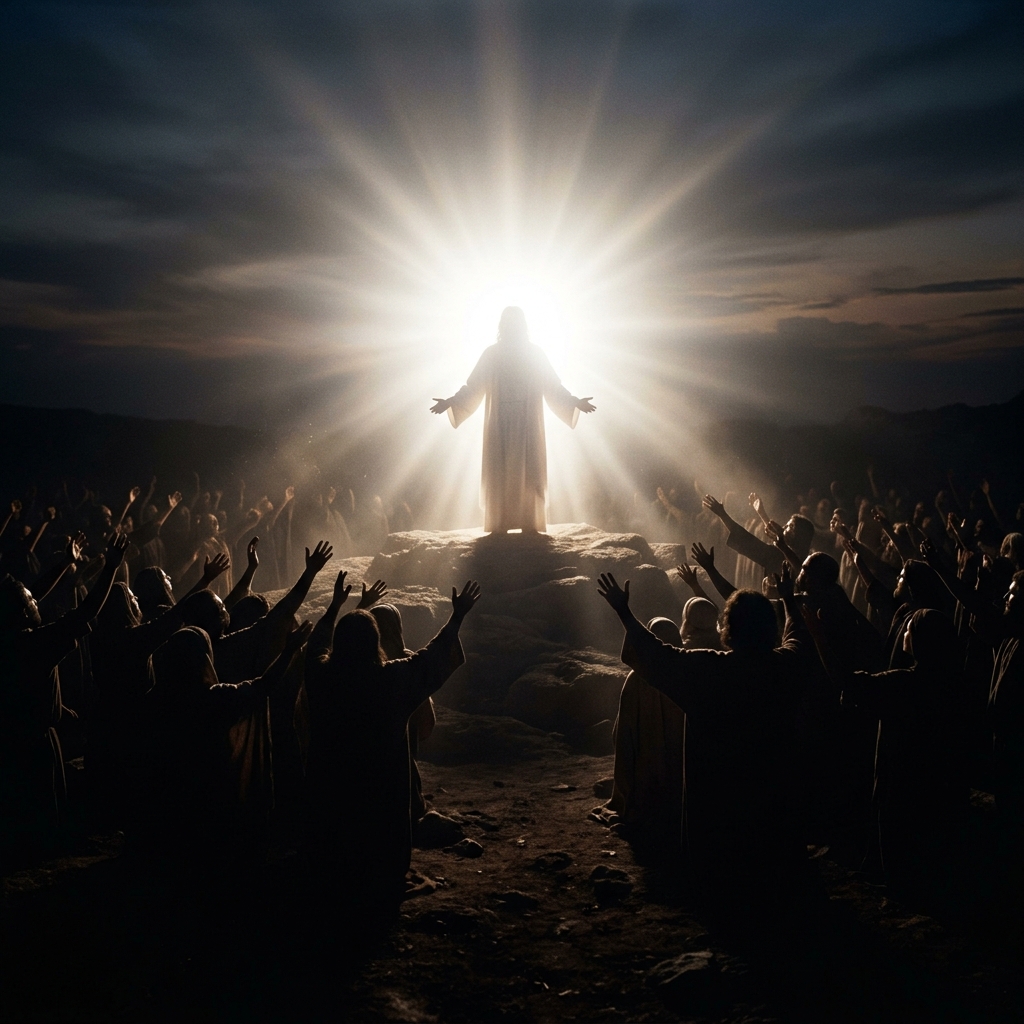
"I am the light of the world" — John 8:12
Every line of Scripture is a coordinate. Every prophecy a vector. Every law a shadow. Every Old Testament sacrifice a rehearsal. They all converge on one point: the Person of Jesus of Nazareth.
He is not merely a revelation of God. He is the revelation of God — the complete, final, and unrepeatable self-disclosure of the Almighty in human flesh.
"In the beginning was the Word, and the Word was with God, and the Word was God… And the Word was made flesh, and dwelt among us."— John 1:1, 14, KJV
The eternal Logos — by which light was commanded into existence — became a man. Touched lepers. Wept at graves. Bled on a Roman cross. Walked out of a sealed tomb. This is not mythology. This is not metaphor. This is the hinge of all history.
Three Inseparable Acts
1. REVELATION — God Spoke It. Truth no human mind could generate: His nature, His plan, His provision in Christ. This happened in history, through real events, real words, real persons.
2. INSPIRATION — God Wrote It. Recorded with absolute fidelity through human authors whose personalities and histories God had sovereignly prepared as instruments. The result: a Book simultaneously fully human and fully divine.
"Holy men of God spake as they were moved by the Holy Ghost."— 2 Peter 1:21, KJV
3. ILLUMINATION — God Opens Your Eyes. Two men can read the same passage. One walks away unchanged. One walks away never the same. The difference is not intelligence — it is illumination. The same Spirit who moved the writers must move the reader.
Nothing Is Hidden From You Anymore
"Thy word is a lamp unto my feet" — Psalm 119:105
The Bible is not a religious book. It is the voice of God crystallized in ink. Every verse is live. Every promise is active. Every warning is current. You are not reading ancient correspondence. You are receiving a transmission from outside of time, delivered to your exact moment.
You are not beyond its reach. Moses was a murderer. David was an adulterer. Paul persecuted Christians. Peter denied Christ three times in a single night. God's revelation was never targeted at the righteous. It was always for the wrecked.
God has spoken. The revelation is complete. The Scripture is in your hands. The Spirit is available. What remains is the response — and that response determines everything.
"Fear not, for I have redeemed thee; I have called thee by thy name; thou art mine."— Isaiah 43:1, KJV
He spoke.
The question is: will you hear?
What the Doctrine of Revelation Teaches
- General revelation — creation, conscience, history — proves God exists, but cannot reveal the way of salvation through Jesus Christ.
- Special revelation — Scripture and Jesus Christ — gives the specific knowledge of God needed to be saved. It is the rescue operation general revelation proves humanity needs.
- Revelation is God's initiative, not man's achievement. Every other religion asks man to climb toward God. The Bible records God descending to man.
- Jesus Christ is not merely a revelation of God — He is the revelation. All of Scripture is a coordinate system pointing to Him.
- The Bible is a live transmission, not a historical archive. Every promise, every warning, every verse — active, present, and addressed to you.
If this stirred something in you — that's not coincidence. That's the Spirit. You don't need to clean yourself up first. You just need to respond.
Start Reading the Bible With Me →Grace Notes Doctrine Series · Vol. II
The Doctrine of Inspiration
HOW GOD GOT HIS WORDS INTO A HUMAN BOOK · WITHOUT ERROR · WITHOUT OVERRIDE
"All scripture is given by inspiration of God, and is profitable for doctrine, for reproof, for correction, for instruction in righteousness." — 2 Timothy 3:16, KJV

A rough table. A worn quill. Words that would outlast every empire ever built.
The most dangerous book ever written was not authored by a king, a philosopher, or a genius. It was authored by a murderer on the run, a shepherd boy turned adulterer, a fisherman who publicly denied he ever knew its subject, and a man who spent years executing the people who believed in it.
And it has never been wrong. Not once. Not in 3,500 years.
That is not an accident. That is not genius. That is Inspiration — the single most world-altering theological fact about the Bible that almost nobody stops long enough to actually understand.

God breathed — and a scarred human hand moved across parchment — and every word was both.
I. Theopneustos — One Greek Word That Changes Everything
When Paul wrote to Timothy that "all scripture is given by inspiration of God," he used a word that had never appeared in any Greek text before that moment. He coined it. He needed a new word because no existing word was sufficient to describe what had happened.
The word is θεόπνευστος — theopneustos.
Break it open: theos — God. pneustos — breathed. God-breathed. Not God-guided. Not God-inspired the way a sunset inspires a painter. God. Breathed. It.
This is the same breath that Genesis 2:7 describes entering Adam's nostrils and making him a living soul. The same breath Ezekiel 37 describes blowing through a valley of dead bones and making an army stand. The same breath John 20:22 records Jesus breathing on His disciples when He said, "Receive ye the Holy Ghost."
"The LORD God formed man of the dust of the ground, and breathed into his nostrils the breath of life; and man became a living soul." — Genesis 2:7, KJV
What God breathed into Adam became the source of human life. What God breathed into Scripture became the source of spiritual life. The same divine breath — now exhaling words instead of oxygen, and those words doing exactly what that first breath did: turning dead things alive.
"The word of God is quick, and powerful."
HEBREWS 4:12 · KJV · "QUICK" MEANS ALIVE
II. The Paradox That Should Stop You Cold
Here is what makes the Doctrine of Inspiration unlike anything in any other religion in the history of the world:
The Bible is simultaneously, completely, 100% human — and simultaneously, completely, 100% the Word of God. Not 50/50. Not a mixture. Both. Fully. At the same time.
Read Paul's letters and you feel Paul — his fire, his logic, his grief. Read David's Psalms and you feel David — his terror, his guilt, his desperate reaching toward a God he knows he has failed. The human voice is real. The personality is real. The emotion is real. And every word is God's.
Theologians call this dual authorship — and the closest parallel in Scripture is not another book. It is a Person:
"And the Word was made flesh, and dwelt among us…" — John 1:14, KJV
Jesus Christ was fully God and fully man — not a God in a human costume, not a man elevated to divine status. Both natures, complete, simultaneously, in one Person. The Incarnation is the key to understanding Inspiration. God did not override Paul's humanity any more than the Spirit overrode Mary's. He worked through it. The same miracle. The same God.
God didn't wait for
clean hands to write His Word.

Broken hands. Perfect words. This is what Inspiration looks like in human history.
III. Broken Men, Perfect Words
If you were God and you were going to write the most important document in the history of the universe — who would you choose? If you answered the holiest, most morally pristine people you could find — you answered wrong. God answered differently.
Murderer. Fugitive. 40-year failure. Killed an Egyptian, fled to the wilderness, argued with a burning bush about why God had the wrong man. Then wrote the first five books of the Bible.
Adulterer. Murderer. Power abuser. Arranged the death of one of his most loyal soldiers to cover up what he did to the man's wife. Then wrote the Psalms — the Bible's own hymnal, the most quoted book in the New Testament.
Terrorist. Mass murderer. Enemy of God. Hunted down Christians, dragged them from their homes, watched them executed. Then wrote 13 books of the New Testament — including the greatest exposition of grace ever written: Romans.
Coward. Public denier. Three-time failure. Cursed and swore and said he never knew Jesus — when it counted most. Then wrote two epistles and became the rock of the early Church.
This is not God settling for imperfect instruments. This is God making a theological statement — His power does not reside in human purity. It resides in divine breath. The vessel's cracks are not obstacles to the treasure. They are the proof that the treasure is not coming from the vessel.
"But we have this treasure in earthen vessels, that the excellency of the power may be of God, and not of us." — 2 Corinthians 4:7, KJV
If you have disqualified yourself from being used by God because of what you've done — you have misread the résumé of every man God chose to write His Word.
IV. Verbal. Plenary. Every Word. Every Part.
There are those who believe God merely inspired the thoughts of Scripture — the general ideas — and the human authors chose their own words. This view collapses under a single observation: Jesus didn't quote ideas. He quoted words.
When tempted in the wilderness: "It is written, Man shall not live by bread alone." Exact words. In Galatians 3:16, Paul builds an entire doctrinal case on the difference between a singular and plural noun — "seed" versus "seeds." One letter. One letter in one word in one verse carries the weight of the entire Abrahamic covenant.
Every word — not just the ideas, not just the spiritual passages. Every. Word. Is. God's.
Every part — genealogies, legal codes, poetry, prophecy, letters. All of it. Fully inspired.
The Bible is not 80% inspired with human filler. It is not a gold mine where you dig through rock to find divine ore. It is entirely, word-for-word, the exhaled breath of God — carried through human personality without corruption, without error, without loss.

2AM. A prison cell. An open Bible. And the breath of God — still alive in every word on every page.
V. What This Means at 2AM in a Cell
Wherever you are reading this — whatever you've done, whatever's been done to you, whatever the walls around you look like — there is something you need to understand about the book that may be the only thing in the room with you right now.
That is not a collection of human wisdom. It is not ancient advice from well-meaning men. It is the breath of the Creator of the universe — preserved, alive, and addressed specifically to you, right now, in this moment.
Every promise in that book is loaded. Every warning is real. Every act of mercy recorded in those pages is God saying: this is who I am. This is what I do. This is still available. The same breath that raised Lazarus, that breathed life into a valley of dry bones, that moved Paul's pen in a Roman prison — is in every verse you read tonight.
"For the word of God is quick, and powerful, and sharper than any twoedged sword, piercing even to the dividing asunder of soul and spirit…" — Hebrews 4:12, KJV
The book in your hands
is still breathing.
What the Doctrine of Inspiration Establishes
- Theopneustos — God-breathed — means Scripture carries the same creative power as the breath that made Adam alive and raised Christ from the dead.
- The Bible is fully human and fully divine simultaneously — the same paradox as the Incarnation, and the same miracle.
- God chose murderers, adulterers, cowards, and terrorists to write His perfect Word — because the power was never in the vessel. It was always in the breath.
- Verbal Plenary Inspiration means every word is God's. Jesus built entire doctrinal arguments on single words and verb tenses.
- The book in your hands right now is not historical. It is alive, active, and exhaling the same breath of God that has never failed a single person who received it.
You are not too far gone for the Word to reach. It has reached further — and brought back worse. Open it. Read it. Let it breathe on you.
Start Reading the Bible With Me →Grace Notes Doctrine Series · Vol. III
The Doctrine of Illumination
WHY TWO PEOPLE CAN READ THE SAME VERSE · AND ONLY ONE BE WRECKED BY IT
"But the natural man receiveth not the things of the Spirit of God: for they are foolishness unto him: neither can he know them, because they are spiritually discerned." — 1 Corinthians 2:14, KJV
Two men sit in the same pew. Same preacher. Same words in the air. The first man shifts in his seat, checks his watch, thinks about lunch. The second man can't breathe. Something just hit him in the chest like a freight train. He doesn't know what to do with his hands. He's trying not to cry in public and losing the fight.
Same words. Same room. Completely different experience.
This is not personality. This is not intelligence. This is not how emotional someone happens to be that day. This is the Doctrine of Illumination — and understanding it will permanently change how you pray before you open your Bible.
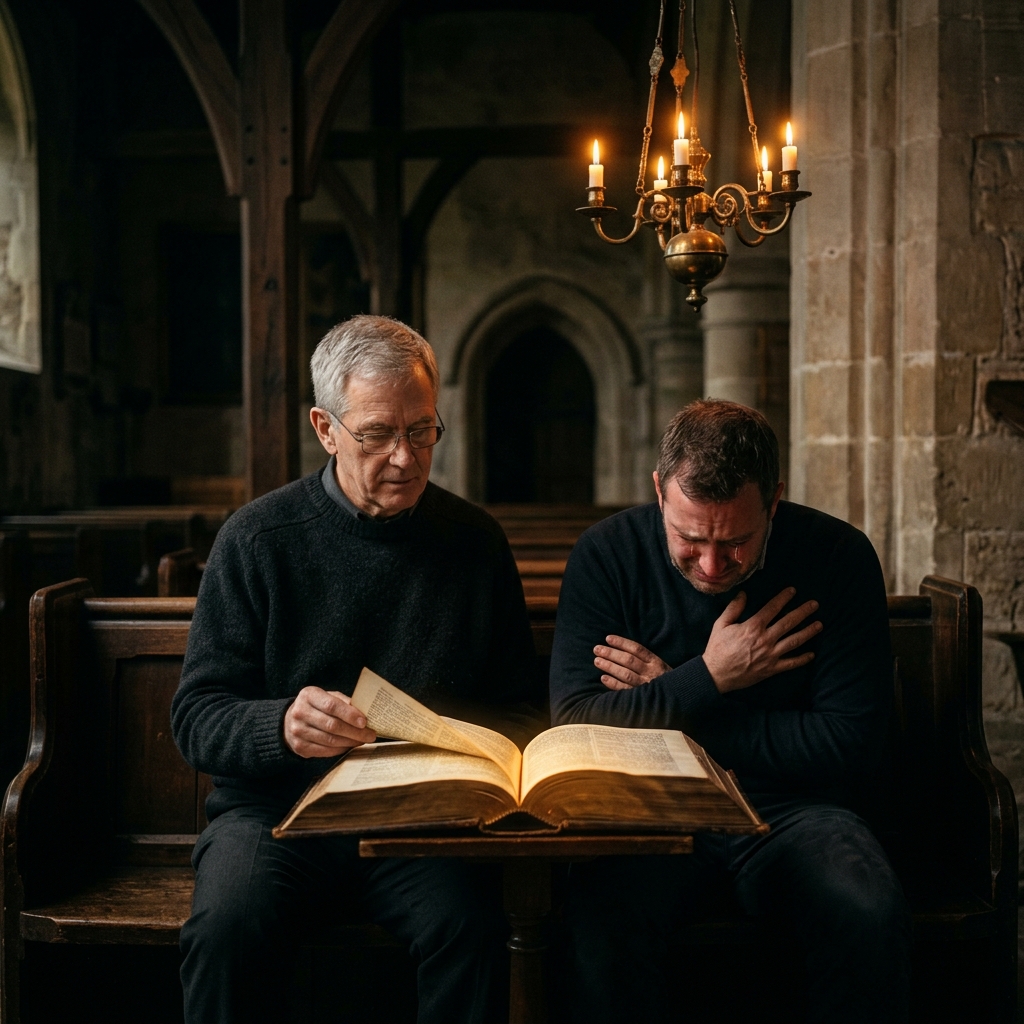
Same Bible. Same verse. One man sees words on a page. The other man meets God.
I. The Lock That Can't Be Picked From the Outside
Here is the problem that every theologian, philosopher, and skeptic eventually runs into whether they admit it or not: the human mind, in its natural state, cannot receive the things of God.
Paul doesn't say the natural man struggles with spiritual truth. He doesn't say the natural man needs a better argument. He says the things of the Spirit are foolishness to him — and that he cannot know them. Not will not. Cannot. The capacity isn't there.
This is not an insult. It's a diagnosis. A man born blind is not insulted by the statement that he cannot see colors. He simply lacks the faculty. The natural man lacks the spiritual faculty to receive what God is saying in His Word — not because the Word is unclear, but because the receiver is broken.
"The heart is deceitful above all things, and desperately wicked: who can know it?" — Jeremiah 17:9, KJV
This means that reading the Bible without the Spirit is like trying to tune into a signal your radio was never built to receive. The broadcast is going out. The signal is perfect. But you're picking up static — or worse, nothing at all.
The signal is perfect.
The receiver is broken.
II. What the Spirit Actually Does
Illumination is the Holy Spirit's act of opening the spiritually blind eye — making a person not just read the Word but receive it. Not just understand it intellectually but be penetrated by it. Not just agree with it but be changed by it.
This is distinct from Inspiration (God breathing the Word out through human authors) and from Revelation (God making Himself known). Illumination is the third act — God shining His light into the reader so that what was already perfectly written is now personally received.
God breathes out — perfect words through human authors. The Word is fixed, complete, without error. Happened once. Done.
God makes Himself known — through creation, through Scripture, through His Son. The disclosure is complete. The record stands.
God shines in — the Spirit opens the blind eye so the already-perfect Word is personally received, understood, and transforming.
A person reads the same verse they've read a hundred times — and this time it lands. Not because the verse changed. Because they did.

The Spirit doesn't add to what's written. He makes what's written reach what's broken.
III. Why You Can't Force It — And How to Ask for It
This is where the Doctrine of Illumination becomes the most practically important theology you will ever study.
You cannot manufacture illumination. You cannot study your way into it. You cannot be smart enough, disciplined enough, or emotionally prepared enough to make it happen. It is entirely a sovereign act of the Spirit — given when He chooses, to whom He chooses, through means He chooses.
But — and this is everything — He has told you how to ask for it.
"Open thou mine eyes, that I may behold wondrous things out of thy law." — Psalm 119:18, KJV
David — the man who wrote more Scripture than almost anyone — still prayed this prayer. Open my eyes. He understood that having the Word in front of him was not the same as receiving the Word. He understood that what he needed was not more study. It was the Spirit turning the key.
This is why the most powerful thing you can do before opening your Bible is not choose the right commentary or the right translation or the right quiet moment. It is to stop and say: God, I cannot understand this without You. Open my eyes. I'm asking You to make this real.
That prayer — three seconds long, spoken honestly — has wrecked more people with the Word of God than every seminary education ever built.
Three seconds.
"Open my eyes."
PSALM 119:18 · THE MOST POWERFUL PRE-BIBLE PRAYER EVER WRITTEN
IV. What It Feels Like When It Happens
You've been reading and nothing is connecting. The words are familiar. You know the chapter. You've heard the sermon. And then — without warning — one verse breaks through the surface and hits something deep, something you didn't even know was there. Your chest tightens. Your eyes fill. You read it again. You read it a third time.
You're not having an emotional moment. You're not projecting feelings onto ancient text. The Spirit just illuminated.
That is the Holy Spirit doing exactly what Jesus promised He would do:
"Howbeit when he, the Spirit of truth, is come, he will guide you into all truth…" — John 16:13, KJV
He guides. Not forces. Not overwhelms. He guides — gently, precisely, personally — making a verse that's been in the text for 3,000 years feel like it was written for you, in your cell, on this specific night, about this specific thing you have been carrying.
Because in the economy of God — it was.
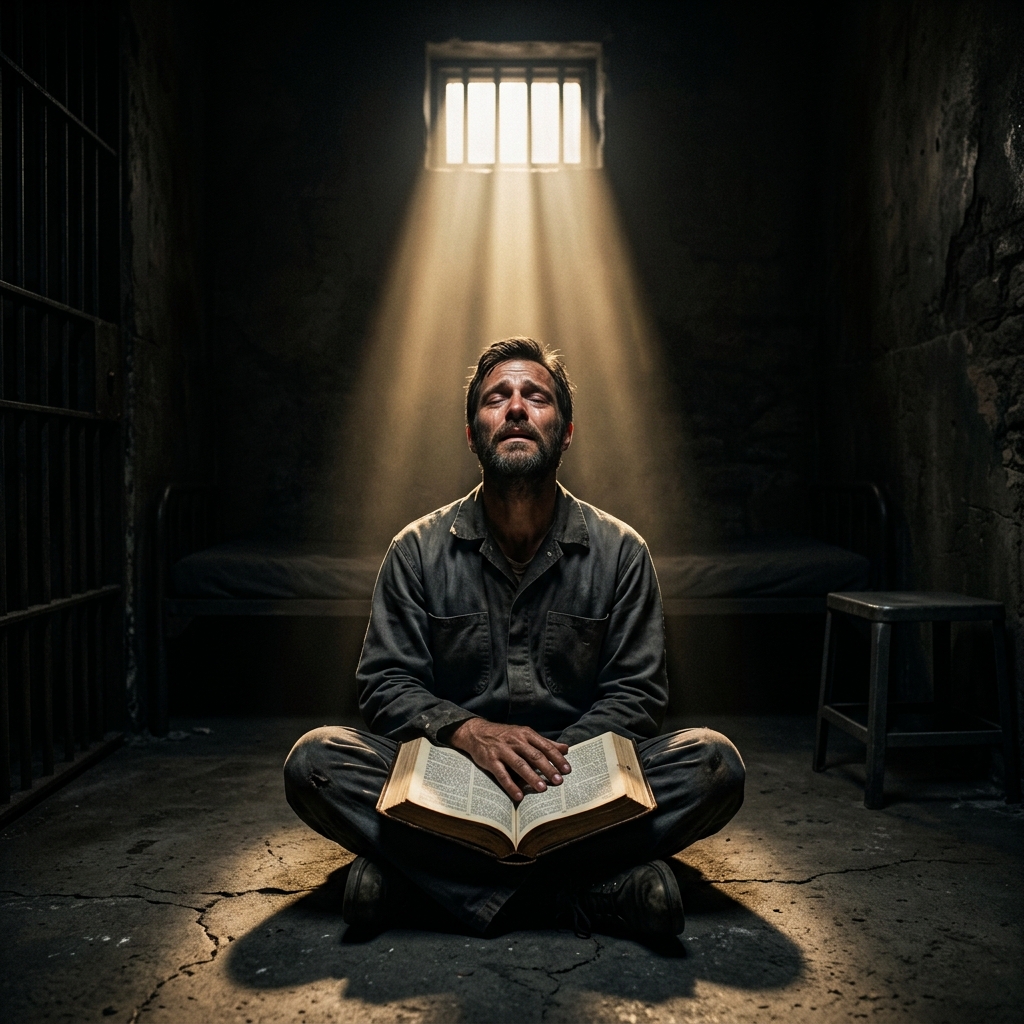
The cell didn't change. The light didn't come through the window. The Spirit opened his eyes — and everything changed.
What the Doctrine of Illumination Establishes
- The natural man cannot receive spiritual truth without the Spirit — not "won't," cannot. This is a diagnosis, not a criticism.
- Illumination is distinct from Inspiration and Revelation — it is the Spirit's ongoing work of opening the blind eye of the reader to already-perfect Scripture.
- You cannot manufacture illumination — but you can ask for it. David prayed "Open my eyes" before reading the Law. That prayer still works.
- When a verse breaks through and wrecks you — that is not emotion. That is the Spirit of God doing precisely what He promised He would do.
- The most powerful thing you can do before opening your Bible is ask God to open your eyes. Three seconds. It changes everything.
Before you close this tab — open your Bible and pray one sentence: "Lord, open my eyes." Then read. See what happens.
Open the Word With Me →Grace Notes Doctrine Series · Vol. IV
The Doctrine of Authority
THE MOST UNPOPULAR DOCTRINE IN THE MODERN WORLD · AND THE MOST NECESSARY
"Heaven and earth shall pass away, but my words shall not pass away." — Matthew 24:35, KJV
The modern world has one theology it is absolutely committed to, and it has nothing to do with God. It is this: nobody gets to tell me what to do.
This theology is everywhere. It is in the music, the courtrooms, the therapy rooms, the social media feeds, the self-help books — the entire architecture of the modern Western mind is built on the premise that authority over your life belongs to you, and anyone who claims otherwise is either oppressive, bigoted, or simply not your problem.
And then there is the Bible. Which does not ask. Which commands.
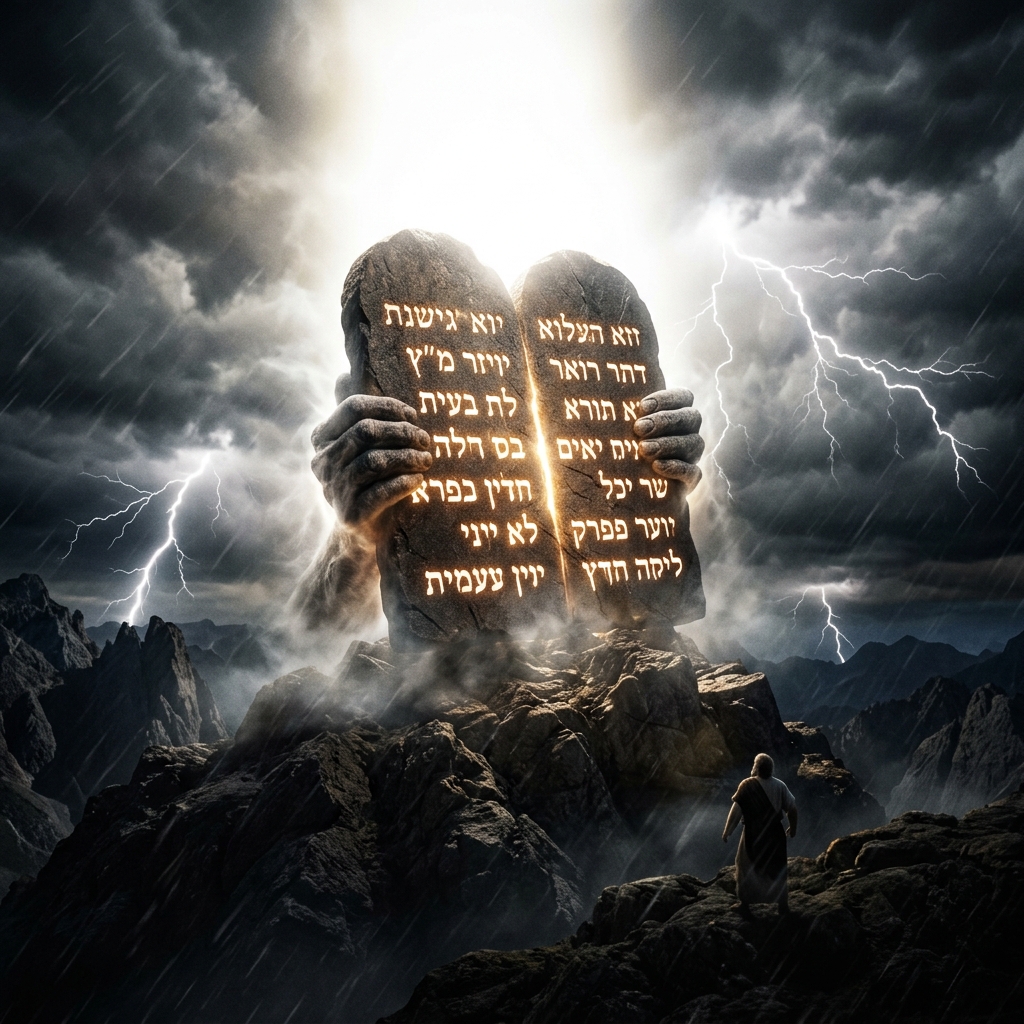
God did not come down to Sinai to offer suggestions. He came to give law. The mountain shook.
I. What Authority Actually Means
The word translated "authority" in the New Testament is the Greek word ἐξουσία — exousia.
It means the right to rule. The legitimate power to issue commands that must be obeyed. Not influence. Not suggestion. Not advice that you can take or leave. The right to rule.
When Jesus finished the Sermon on the Mount, Matthew records the crowd's response:
"And it came to pass, when Jesus had ended these sayings, the people were astonished at his doctrine: For he taught them as one having authority, and not as the scribes." — Matthew 7:28–29, KJV
The scribes taught with footnotes — "Rabbi so-and-so says this, but Rabbi such-and-such disagrees." They were curators of other people's opinions. Jesus said: "But I say unto you." Full stop. No committee. No vote. No appeal process. The Author was speaking.
When the Author of a document speaks about what that document means — that is not one interpretation among many. That is the final word. And the Bible is not merely a document about God. It is the word of God — which means its authority is not derived from church councils, scholarly consensus, or personal agreement. Its authority is intrinsic. It carries the weight of the One who breathed it.
The Author
was still in the room.
II. The Most Dangerous Phrase in Modern Christianity
There is a phrase that has quietly destroyed more people's relationship with God than almost any heresy in church history. It sounds humble. It sounds thoughtful. It sounds like the product of careful reflection. It is none of those things.
The phrase is: "I don't think God would really want me to…"
Fill in the blank with whatever the Scripture clearly says and the person clearly doesn't want to do. I don't think God would really want me to forgive that person. I don't think God would really want me to give up this relationship. I don't think God would really want me to stop. I don't think God would really want me to go back and make that right.
This phrase does not sound like rebellion. But it is — at its core — the oldest move in the book. It is the serpent in the garden saying "Hath God said?" It is placing your own reading of God's character above what God has actually said. It is making yourself the authority over the Word instead of placing yourself under it.
"There is a way which seemeth right unto a man, but the end thereof are the ways of death." — Proverbs 14:12, KJV
The Bible doesn't just say that way leads to problems. It says that way leads to death. The stakes of rejecting the authority of Scripture are not mild inconvenience. They are the full weight of what you become when you make yourself the final judge of your own life — which is a person answering to no one but yourself, which is a person with no compass, which is a person who will eventually arrive somewhere terrible and have no idea how they got there.

Authority is not cruelty. A good king's law protects his people. That is exactly what this is.
III. Why Authority Is a Gift, Not a Prison
Here is what the modern world has completely backward about the authority of Scripture: it frames authority as the enemy of freedom. The Bible says the opposite — that submission to the authority of God's Word is the only path to real freedom.
"And ye shall know the truth, and the truth shall make you free." — John 8:32, KJV
This is not metaphor. This is mechanics. The truth — the actual, authoritative, non-negotiable word of God — is what breaks things loose that nothing else can touch. The man who submitted to Alcoholics Anonymous's program didn't feel free when he was told he couldn't drink. He felt constrained. And then years later he looked at his intact family, his intact mind, his intact life — and understood that the constraint was the freedom.
The authority of Scripture works the same way. The man who submits his anger to "be ye angry and sin not" (Ephesians 4:26) doesn't feel free in the moment. The man who submits his tongue to "let no corrupt communication proceed out of your mouth" (Ephesians 4:29) doesn't feel free in the moment. But the man who has been doing both for five years — look at his relationships. Look at his peace. Look at what didn't happen to him that happens to everyone who refuses the authority.
The authority of the Bible is not a cage. It is the structural integrity of a life that doesn't collapse.
Every decision filtered through "what do I want?" — leading to a self that is sovereign and therefore accountable to nothing, correctable by nothing, protectable by nothing.
Every decision filtered through "what does God say?" — leading to a self that is anchored, correctable, and protected by the One who actually knows where each path leads.
"Your truth. Your rules. Your life." — and then wondering why the life that belongs entirely to you feels like it's falling apart entirely on its own.
"My word will not return void." (Isaiah 55:11) — Every command obeyed, every truth submitted to, every "not my will but thine" produces something that self-rule never could.
IV. What Obedience Actually Looks Like From the Bottom
This isn't a doctrine for people who have it together. This is a doctrine for people who know exactly what it costs to ignore it.
If you're reading this from a cell — you already know what the end of "nobody tells me what to do" looks like. You have already lived in that house. You know what the rooms smell like. You know what it costs. You don't need a theologian to explain the consequences of rejecting authority. You have the receipts.
Which is exactly why this doctrine hits differently for you than it does for someone who's never been to the bottom. You know what the alternative actually is. Not as a concept. As a lived reality.
And so when the Bible says obey — you're not hearing it the way a comfortable suburban churchgoer hears it, as a vague moral suggestion to feel slightly convicted about. You're hearing it as a man who knows what disobedience actually produces. As a man who has already paid the price of his own authority and found it bankrupt.
That is not a disadvantage. That is the closest thing to wisdom you can have without God giving it to you directly.

You already know where the dark path goes. You've been down it. The Bible is telling you to take the other one.
You already know
what the other path costs.
What the Doctrine of Authority Establishes
- Exousia — the right to rule. Jesus taught as one having authority because He was the Author. The Bible carries that same intrinsic weight.
- "I don't think God would want me to…" is not humility — it is the oldest form of rebellion: placing your reading of God above what God actually said.
- The authority of Scripture is not a cage. It is the structural integrity of a life that doesn't collapse. Constraint and freedom are not opposites here — they are the same thing.
- The man who has already lived on the wrong side of authority has a unique advantage: he knows the cost. That knowledge, submitted to God, becomes the foundation of a different life.
- God's word will not return void (Isaiah 55:11). Every act of obedience — however small, however costly — produces something that self-rule never could.
The Doctrine Series is complete. Four volumes. One truth running through all of them: God spoke. God preserved it. God opens eyes to receive it. And God's Word has the right to rule your life. The question is whether you will let it.
Start Walking In It →
"For the word of God is quick, and powerful, and sharper than any twoedged sword." — Hebrews 4:12, KJV
Four Doctrines. One Foundation.
Everything you need to trust the Bible — and let it trust you.
Revelation — God Speaks
He doesn't wait for man to climb toward Him. Through creation, conscience, Scripture, and His Son — God descends. Every person has received the first signal. The question is whether they respond.
Inspiration — God Preserved Every Word
He didn't just speak — He superintended the writing. Forty broken men, three continents, sixteen centuries, zero contradictions. God breathed (theopneustos) — and the vessel's cracks proved the treasure wasn't coming from the vessel.
Illumination — God Opens the Blind Eye
The natural man cannot receive spiritual truth — not will not, cannot. The Spirit's job is to shine in. Three words before you open your Bible — "Open my eyes" (Ps 119:18) — change everything about what happens next.
Authority — God Has the Right to Rule
He didn't ask — He commands. Not cruelty; architecture. The man who submits his anger, his tongue, his decisions to what God actually said ends up with something that self-rule could never produce: a life that doesn't collapse.
Theology of Divine Revelation & Inspiration
- St. Irenaeus of Lyons (c. 130–202 AD), Against Heresies, Book III: “On Special Revelation and the Divine Inspiration of the Scriptures through the Holy Ghost.”
- St. Augustine of Hippo (354–430 AD), On Christian Doctrine, Book II: “The Necessity of Holy Spirit Illumination to Understand Holy Scripture.”
- Thomas Aquinas (1225–1274 AD), Summa Theologica I, Q. 1 (On Sacred Doctrine, Its Nature and Its Divine Authority).
Frequently Asked Questions About Biblical Doctrine
What is the difference between General Revelation and Special Revelation?
General revelation is God's disclosure of Himself to all humanity through creation and conscience (Romans 1:20). Special revelation is God's specific disclosure through Holy Scripture (KJV) and Jesus Christ.
What does the Doctrine of Inspiration mean in KJV Scripture?
Inspiration (theopneustos) means that Scripture is 'God-breathed' (2 Timothy 3:16) — divine truth communicated without error through human authors.
Why is Holy Spirit Illumination necessary to understand the Bible?
The natural man cannot receive the things of the Spirit (1 Corinthians 2:14). Illumination is the Holy Spirit opening the believer's heart and mind to perceive already revealed truth.
Four Volumes. One Truth.
God Spoke. Will You Hear?
He revealed Himself. He preserved every word. He opens blind eyes to receive it. And His Word has the right to govern your life. Four doctrines. One foundation. The question is what you do next.
Lord, I believe You spoke.
I believe You preserved every word without error.
I believe Your Spirit has to open my eyes for me to truly receive it.
And I believe Your Word has the right to rule my life — not just advise it.
So I'm not asking You to fit into what I already think.
I'm asking You to break through whatever is blocking me from hearing You.
Open my eyes. Change my mind. Rule my life.
I surrender the authority back to You.
In Jesus' name. Amen.
OPENS IN NEW TAB · PRINT OR SAVE AS PDF · FREE TO SHARE