
When the Dawn Finds You on the Moors
It is three in the morning, a thin mist clings to the heather, and the wind carries the scent of peat. A lone shepherd walks his flock across a ridge, his breath frosting in the chill as he watches the hills awaken. The sky is a bruised violet, and the distant church spire catches the first pale light, casting a hopeful glow over the landscape. In that hush the heart recalls the ancient truth that a prophet (Greek: προφήτης, *prophētēs*) is not honored in his own country, a reality that can make even the most steadfast soul feel isolated. Yet this very silence becomes a holy invitation, for when we still our chatter the Spirit can speak louder than any distant bell.
The Scripture that meets this moment is found in Matthew 13:57‑58 (Matt. 13:57‑58, KJV), where the people of Nazareth scoffed at the carpenter's son. They asked, "Whence hath this man these things?" and their answer was a stumbling block: they were offended. Jesus answered, "A prophet is not without honour, save in his own country, and in his own house" (Greek: *prophetes*). This verse cuts straight to the marrow of rejection that still haunts any familiar place, and it reminds us that God's love does not shrink because of familiarity. Moreover, the passage bridges the Old Covenant promise of a suffering servant (cf. Isaiah 53) with the New Testament reality of Christ's incarnation, showing the continuity of God's redemptive plan.
Yet the same passage also shows how the Gospel turns offense into invitation without overstating a causal link. The very moor that heard the scorn became, through God's providence, a field where His words were recorded for all ages—a classroom of grace rather than a tomb of rejection. When we read the verse through the lens of mercy, the moor becomes a place where Christ's compassion teaches that even our own hometown can be a site of redemption. The KJV words carry the weight of history and hope, showing that God's purpose can work even where belief is thin. Thus the moor, once a backdrop for unbelief, now stands as a stage where divine grace can be displayed, echoing the covenant promise that God will bring life from barren ground.
The self‑reliant mindset is a house built on sand; as Jesus warns in Matthew 7:24‑27 (Matt. 7:24‑27, KJV), only the foundation of His truth endures when the storm comes. When we trust our own strength, we echo the folly of those who built without hearing God's voice. Yet when we lay each brick upon Christ's teaching, the house stands firm against every gale. This image completes our theological journey from rejection to redemption, reminding us that true security is found only in the living Word.
"And they were offended in him. But Jesus said unto them, A prophet is not without honour, save in his own country, and in his own house. And he did not many mighty works there because of their unbelief."— Matthew 13:57-58, KJV
The Failure of Self‑Righteousness on the Dales
A farmer in the dales may labor from dawn till dusk, believing that sweat and skill will earn him favor. He tills the soil, prays for rain, and counts his harvest as proof of worthiness. Yet each season he finds that the earth yields only what He allows, and his pride crumbles when a storm washes away his labors. The self‑reliant mindset is a house built on sand, and it collapses when the wind of truth blows. Scripture shows that no amount of effort can replace the righteousness that comes from Christ alone.
The finished work of Jesus stands as the antidote to our performance‑based anxiety. John 14:21 declares, "He that hath my commandments, and keepeth them, he it is that loveth me: and he that loveth me shall be loved of my Father, and I will love him, and will manifest myself to him." The verse does not demand a checklist; it offers an invitation into love that covers all our attempts. When we cling to the cross, guilt evaporates, and the weight of self‑approval lifts. The believer discovers that true honour comes from being loved, not from being industrious.
The deeper exegesis of John 14:21 reveals a relational covenant, not a legal contract. Jesus ties love for Him with obedience that flows from gratitude, not fear. The KJV phrasing "keepeth them" suggests a gentle holding rather than a harsh enforcement. By keeping His commandments, we align our hearts with the Father’s desire, and He promises to manifest Himself. The verse therefore transforms a duty into a delight, showing that obedience is the fruit of love, not its cause.
"He that hath my commandments, and keepeth them, he it is that loveth me: and he that loveth me shall be loved of my Father, and I will love him, and will manifest myself to him."— John 14:21, KJV
Living the Grace of a Sacred County
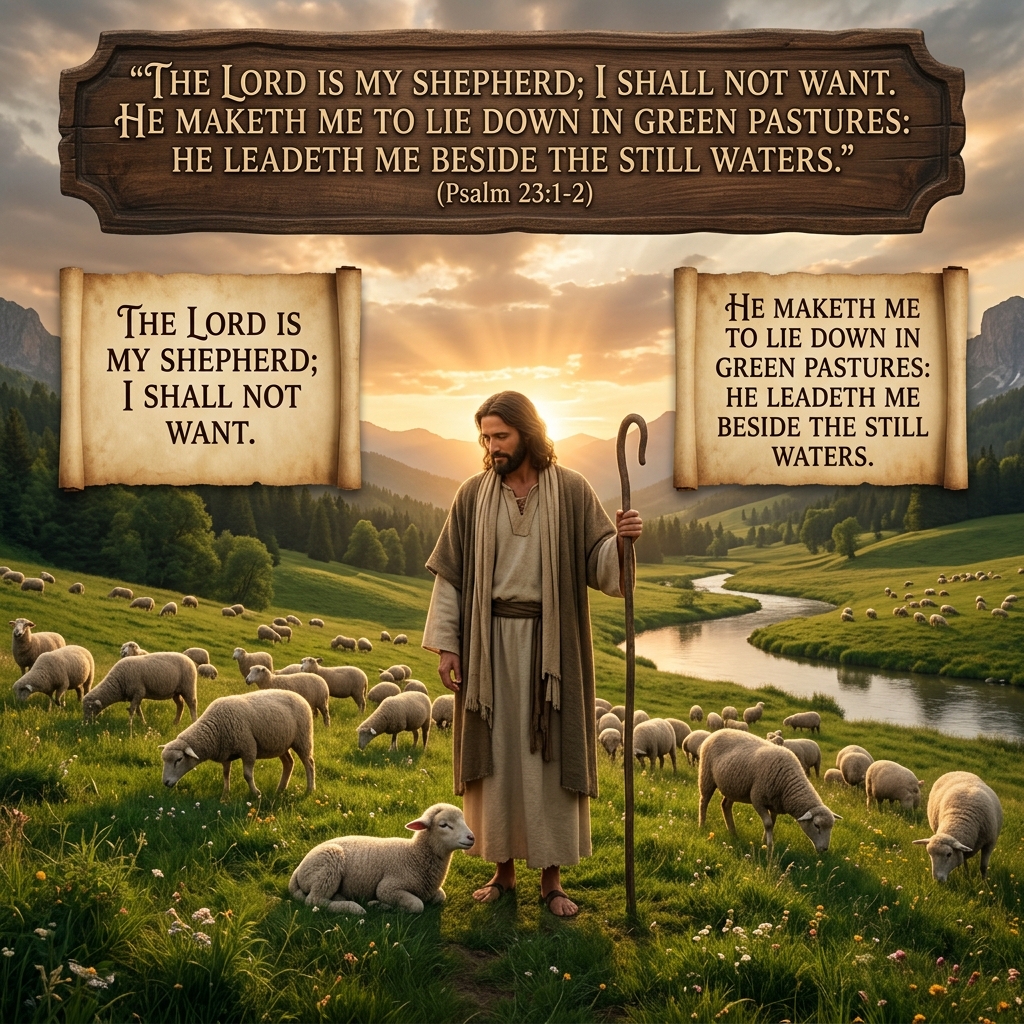
A family gathers around a peat fire in a cottage near the Dales, children laughing while the wind rattles the shutters. The eldest daughter reads Psalm 23 aloud, and the verses settle like a warm blanket over the room, echoing the shepherd‑king motif (Hebrew: רֹעֶה *ro'eh*). In that ordinary moment the presence of God becomes palpable, as if the hills themselves were breathing His peace. The verse "He leadeth me beside the still waters" (Psalm 23:2, KJV) speaks directly to the anxiety that often grips a busy heart, reminding us of the covenant promise that the Lord is our perpetual guide. A self‑reliant mindset, however, is a house built on sand; as Jesus declares in Matthew 7:24‑27 (Matt. 7:24‑27, KJV), only the foundation of His truth endures when the storm comes. When we let the Psalm’s promise soak into our lives and lay each day upon Christ’s teaching, we transform a simple hearth into a sanctuary of grace.
"The LORD is my shepherd; I shall not want. He maketh me to lie down in green pastures: he leadeth me beside the still waters."— Psalm 23:1‑2, KJV
Standing on the Rock of God's Promise
The foundation of our hope rests on the unchanging Word that declared, "A prophet is not without honour, save in his own country" yet also promised that the same Christ would bring salvation to all who believe. The paradox is striking: He was rejected where He began, yet the same land bears witness to His glory through the gospel. The KJV assures us that God's purposes are not thwarted by human short‑sightedness; they are woven through it. When we stand on this truth, the hills of Yorkshire become a reminder that God's promise endures beyond our doubts.
If we return to the mindset of performance, we trade the freedom of grace for the bondage of legalism. The danger is subtle: a desire to be seen as good can eclipse the desire to be loved. Matthew 13:58 warns that "He did not many mighty works there because of their unbelief." The verse is a cautionary echo that unbelief can silence miracles. Let us therefore guard our hearts against the temptation to earn God's favour, and instead cling to the assurance that He works in us even when we cannot see it.
"And he did not many mighty works there because of their unbelief."— Matthew 13:58, KJV
✨ What To Do Today
- Journal prompt: Describe a moment when you felt God's presence in an ordinary place, then compare it with the scene of the early morning moor.
- Scripture meditation: Read Matthew 13:57-58 and John 14:21 slowly; ask God, "How does Your love transform my ordinary surroundings?"
- Practical step: Spend ten minutes this week walking a local field or lane, intentionally listening for God's voice in the wind.
- One act of surrender: Identify a task you try to earn favor through; name it, lay it down, and cling to John 14:21.
May the mist on the Yorkshire moors remind you that God's presence is often veiled in the ordinary. May each sunrise over the dales be a reminder that He who was rejected there now stands ready to honor you. Let your daily tasks become prayers, and let each quiet moment be a conversation with the Savior who loves you beyond measure. When doubt tries to cloud your view, remember that a prophet can be honoured even in his own country. Walk forward with the confidence that God's promise holds firm, and that His grace is sufficient for every step. May you find peace in the knowledge that heaven walks beside you on these ancient hills.