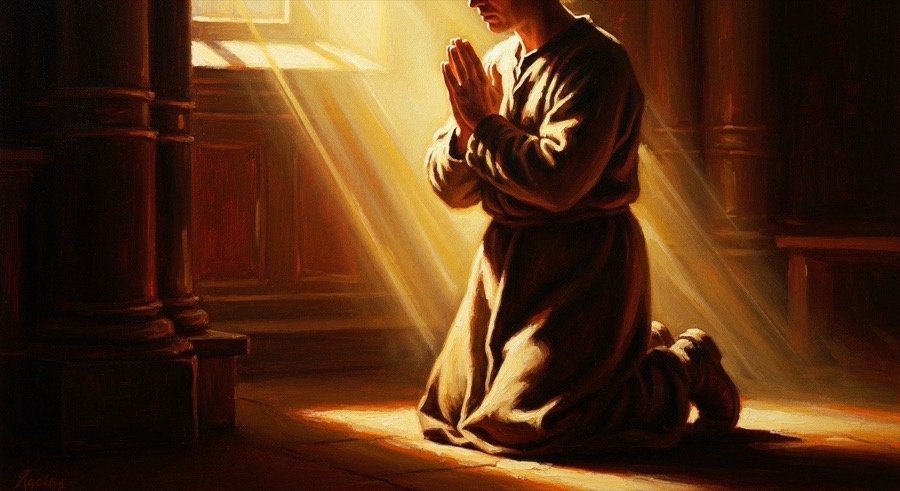
The silence can be deafening, can't it? You’ve prayed with tears streaming down your face. You’ve stormed the gates of heaven with fasting and petitions.
- When 'Good Gifts' Don't Look Like What You Asked For: Trusting God's Word through life's deepest trials and seasons of waiting.
- An Answer Walking on the Water: Trusting God's Word through life's deepest trials and seasons of waiting.
- The Father's Cup and Our Fiercest Prayers: Trusting God's Word through life's deepest trials and seasons of waiting.
When 'Good Gifts' Don't Look Like What You Asked For
The silence can be deafening, can't it? You’ve prayed with tears streaming down your face. You’ve stormed the gates of heaven with fasting and petitions.
You’ve quoted every promise in the book back to the One who wrote it. And yet, the only answer you hear is the echo of your own plea. ' You want to scream back, 'Don't you think I'm trying?
The pain of unanswered prayer is real and it is raw. It is not a failure of your faith. It is, however, an invitation into a deeper dimension of it. Jesus Himself addresses the heart of the Father with a profound simplicity that we often overlook in our desperation for a specific outcome. He speaks of a Father who is fundamentally good, whose very nature is to give.
' Notice what He doesn't say. He doesn't promise to give you the *exact* things you ask for. He promises to give *good* things. And here is the terrifying, beautiful truth: His definition of 'good' and our definition of 'good' are often worlds apart.
We pray for comfort, and He knows the only path to true strength is through the trial. We pray for the removal of a problem, and He plans to give us the power to overcome it. We pray for an easier path, and He, knowing the end from the beginning, sees that the narrow way is the only one that leads to life. ' To trust God in this space is to believe His character is more reliable than your circumstances.
If ye then, being evil, know how to give good gifts unto your children, how much more shall your Father which is in heaven give good things to them that ask him?— Matthew 7:11, KJV
An Answer Walking on the Water
Think of the disciples in that boat. ' They had just witnessed the miracle of the five loaves and two fishes. They had seen Jesus feed five thousand men with a boy's lunch. If anyone should have had faith, it was them.
But fear has a way of erasing the memory of yesterday's miracles. They were in the middle of the sea, and Jesus was on the mountain praying. They were alone, exhausted, and terrified. I can almost hear their prayers, shouted over the wind: 'Lord, stop the storm!
And how did God answer? Did the wind suddenly cease? Did the waves instantly calm? No. The answer to their prayer came walking on the water in the fourth watch of the night. But here's the critical part: they didn't recognize the answer when it came.
' They were praying for a rescue, and when the Rescuer arrived, they mistook Him for a monster. How often do we do the same? We plead with God to change our situation, but His answer is to enter the situation *with* us. The answer to our prayer for peace isn't always the absence of the storm, but the presence of the Master in the boat. The healing we receive may not be for the body, but for the soul's deep-seated fear. The provision may not be a change in our bank account, but a supernatural contentment in what we have.
The reason we often feel our prayers are unanswered is because we are looking for a change in our circumstances, while God is looking for a change in our character. We want a God who works *for* us, like a cosmic vending machine. He wants to be a God who works *in* us, shaping us into the image of His Son. When they finally recognized Him, Jesus spoke the words that every soul in a storm needs to hear: 'Be of good cheer: it is I; be not afraid.' The answer wasn't the end of the storm; the answer was Emmanuel, God with us.
For they all saw him, and were troubled. And immediately he talked with them, and saith unto them, Be of good cheer: it is I; be not afraid.— Mark 6:50, KJV
The Father's Cup and Our Fiercest Prayers
There is no prayer in history more agonizing, more raw, or more holy than the one prayed by Jesus in the Garden of Gethsemane. 'O my Father, if it be possible, let this cup pass from me.' If ever a prayer deserved a 'yes,' it was this one. It was a perfect prayer from a perfect Son to a perfect Father. And the answer was no. The silence from heaven was a confirmation that the cross was the only way. The salvation of all humanity hung on this one, devastating, unanswered prayer.
In that moment, Jesus modeled for us the highest form of faith. It's not the faith that demands God bend to our will, but the faith that bends to His. His prayer didn't end with his request; it ended with His surrender: 'nevertheless not as I will, but as thou wilt.' Later, as the soldiers came to arrest Him and Peter drew his sword to fight, Jesus rebuked him with a question that pierces the heart of every unanswered prayer: 'the cup which my Father hath given me, shall I not drink it?' He understood that the Father's 'no' to His temporary relief was a 'yes' to eternal redemption for us all.
This is the hardest part of the journey. To accept that sometimes, the suffering is the path. The sickness is the crucible. The loss is the pruning that produces a fruit we cannot yet imagine.
God's purpose is not our comfort; it is our conformation to the image of Christ. Sometimes, God allows the unanswered prayer because the process of wrestling with Him, of learning to trust Him in the dark, of surrendering our will to His, is the very thing that saves us. It strips away our self-reliance and forces us to cling to Him alone. It teaches us that our ultimate hope is not in receiving what we ask for, but in receiving Him, the Giver.
The disciples' unbelief, even after seeing the risen Christ, is a comfort to us. They were hard of heart, and Jesus upbraided them for it. Yet He did not abandon them. Instead, He commissioned them.
Your season of doubt and unanswered prayer is not a disqualification from service. It may very well be your qualification. It is in the soil of our deepest questions and our most profound pain that a resilient, unshakeable faith can finally take root. To trust God is not to have all the answers, but to be held by the One who is the Answer.
Then said Jesus unto Peter, Put up thy sword into the sheath: the cup which my Father hath given me, shall I not drink it?— John 18:11, KJV
Do not lose heart, beloved. The silence you feel is not absence. The waiting is not wasted. Your Father, who knows how to give good gifts, is at work.
He may not be removing the mountain, but He is giving you the strength to climb it. He may not be calming the storm, but He is walking on the waves to meet you in it. Your unanswered prayer is not a sign of His displeasure, but an invitation into the depths of His love—a love that was willing to endure the ultimate unanswered prayer so that you would never, ever be truly alone.