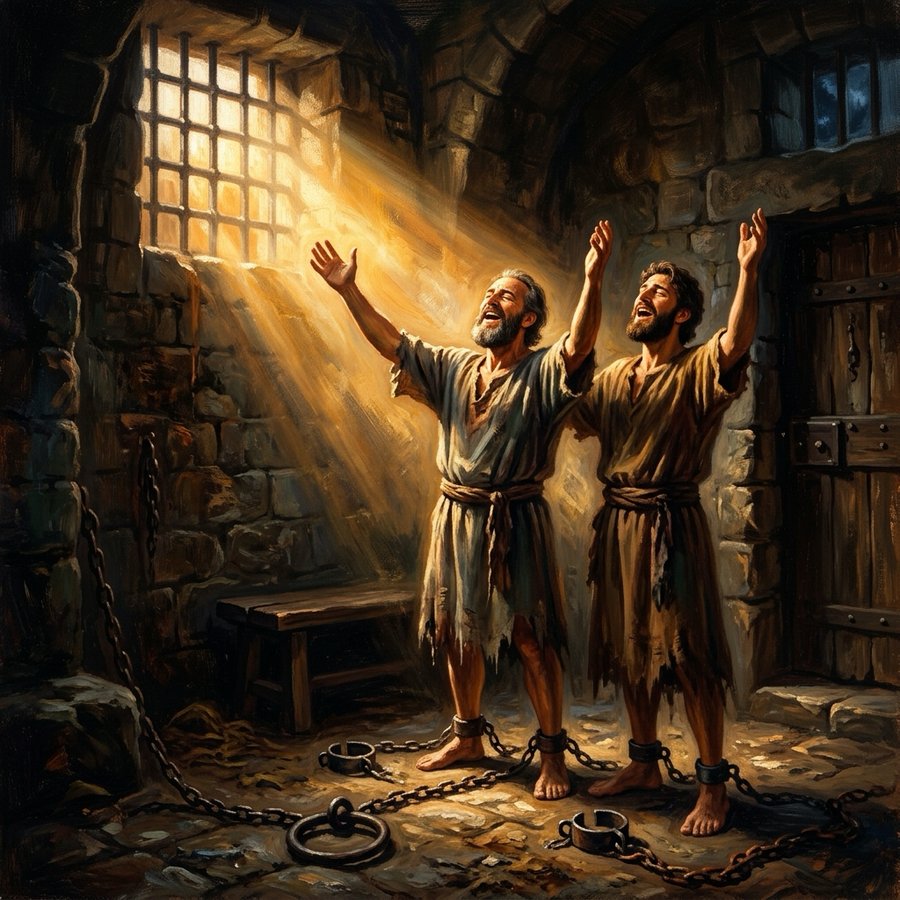
They had been beaten. With rods — the Roman soldiers didn't go easy. Their backs were open. Their feet were fastened in stocks. They were in the innermost cell of a Roman prison in Philippi, and it was midnight. The darkest hour of the darkest kind of night.
And Paul and Silas were singing.
"But at midnight Paul and Silas were praying and singing hymns to God, and the prisoners were listening to them. Suddenly there was a great earthquake, so that the foundations of the prison were shaken; and immediately all the doors were opened and everyone's chains were loosed."— Acts 16:25-26 (KJV)
The prisoners were listening. Because this was not the sound that midnight usually makes. Midnight usually sounds like silence, or weeping, or the grinding of men against their circumstances. Midnight doesn't usually sound like worship. And when it does — heaven notices.
They had been beaten. With rods — the Roman soldiers didn't go easy. Their backs were open. Their feet were fastened in stocks. They were in the innermost cell of a Roman prison in Philippi, and it was midnight. The dark...
- The Praise That Costs You Something: Trusting God's Word through life's deepest trials and seasons of waiting.
- Why Praise Is Warfare: Trusting God's Word through life's deepest trials and seasons of waiting.
- What Shook in Philippi: Trusting God's Word through life's deepest trials and seasons of waiting.
The Praise That Costs You Something
There is a category of praise that is easy. Praise when everything is going well. Praise on Sunday morning when you feel it. Praise when the answer has arrived and the breakthrough is visible and gratitude flows naturally.
God receives that praise. But there is another category — the praise that costs you something. The praise that has to be a decision rather than a feeling. The praise that rises from your chest when your chest is full of something else entirely, and you have to push past that something else to get to the song.
That is the praise that cracks foundations. That is the praise that opens doors.
Paul and Silas were not pretending they weren't in chains. They were choosing to sing anyway. They were making a declaration with their voices that their circumstances were not the final word — that the God who called them to Philippi was still God in the Philippi prison, that suffering was not evidence of His absence, that their story was not over just because it felt like it was.
Why Praise Is Warfare
The enemy's fundamental strategy is to make you doubt the goodness of God. If he can't get you to deny God exists, he'll settle for getting you to believe God is either absent, uninvested, or too small for this particular situation. Despair is his preferred weapon. Silence — the silence of a soul that has stopped speaking to and about God — is his preferred environment.
Praise destroys both. You cannot genuinely praise God and simultaneously believe He is absent from your prison. You cannot sing of His faithfulness and simultaneously believe this situation is too much for Him. Praise is a weapon because it is a declaration of truth in the face of a lie — and the enemy has no counter to that.
"Let the high praises of God be in their mouth, and a two-edged sword in their hand."— Psalm 149:6 (KJV)
Praise and warfare, side by side. The mouth and the sword. The song and the battle. They have always been the same thing.
What Shook in Philippi
When the earthquake came, it was indiscriminate. All the doors opened. Everyone's chains loosened — not just Paul and Silas. The worship of two prisoners made freedom available to everyone else who was listening. The jailer, seconds from killing himself in shame, heard Paul's voice and ran trembling into the cell. By morning he was baptized with his entire household.
One midnight song. One act of costly praise. And the ripple effects touched every person in that building and generations of that family beyond it.
You do not always know who is listening when you praise at midnight. You do not always know whose chains are loosened when you choose worship in the dark. But you are never just singing for yourself. The prisoners are always listening.
Your Midnight
What is your midnight? What is the prison that has you in its innermost cell — the situation that feels most locked, most hopeless, most like morning is never coming? That is the exact location where midnight praise is most powerful. Not because singing makes it all immediately better, but because singing declares — to your own soul, to the enemy, to every prisoner listening — that you belong to a God who specializes in earthquakes.
Start with whatever you have. A whisper. A half-remembered hymn. A Scripture prayed aloud because something in you won't let the silence win. God hears midnight songs. And He moves for the ones who sing them.