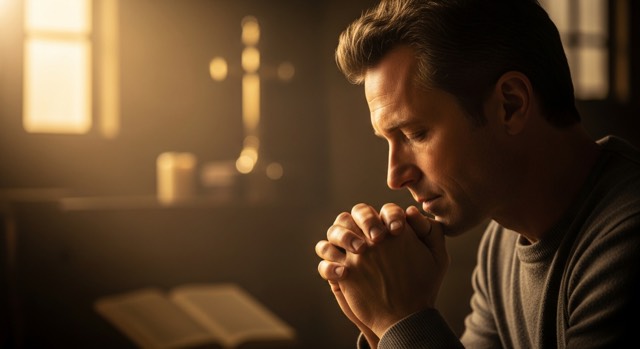
It was past midnight; the house on the hill seemed empty, yet a father paced the floor, his mind tangled in worry. His servant lay on a pallet, breath shallow as if clinging to the faint flicker of candlelight. The fathe...
- A Centurion’s Trust: Trusting God's Word through life's deepest trials and seasons of waiting.
- The Power of Faith: Trusting God's Word through life's deepest trials and seasons of waiting.
- Living in the Grace of Christ: Trusting God's Word through life's deepest trials and seasons of waiting.
A Centurion’s Trust
It was past midnight; the house on the hill seemed empty, yet a father paced the floor, his mind tangled in worry. His servant lay on a pallet, breath shallow as if clinging to the faint flicker of candlelight. The father had heard whispers among the townsfolk about a man named Christ who healed with a word, and he dared to send his messenger across the sea. The centurion, steeped in Roman discipline, approached Jesus with a humility that surprised his own rank. He fell at his feet and pleaded, “My servant lieth at home sick of the fever.”
Jesus answered with a calm that cut through the night’s silence, “I am not worthy to have thee come under my roof.” Yet He added, “Go thy way; and as thou hast believed, so be it done unto thee.” The servant rose before the sunrise. This moment in Luke 7:9-10 showcases a faith that transcended social boundaries and convinced the Savior to act. It is an image of trust placed in God’s authority, not in human status.
The centurion’s belief was not rooted in works but in the recognition of Christ’s sovereign power. He understood that authority, when placed upon the Son of Man, could overcome any earthly condition. The KJV reminds us that “the kingdom of God is not meat nor drink; but righteousness, and peace, and joy in the Holy Ghost” (Romans 14:17). This truth forever changes our approach to spiritual battles, shifting from self-reliance to the assurance that Christ’s word alone suffices.
"And Jesus answered and said unto them, For verily I say unto you, I have not found so great faith, no, not in Israel."— Luke 7:9, KJV
The Power of Faith
A woman who had suffered twelve long years with a relentless flow of blood could not have found relief through any doctor's skill. She had spent every coin she owned, yet her condition worsened, a heavy burden that clung to her like a second skin. When she learned of Jesus’s presence, she slipped through the crowd with one desperate thought: “If I may touch but His clothes, I shall be whole.” The moment she brushed the hem, a fountain of blood dried up. Jesus turned to ask, “Who touched my clothes?”
Jesus’s response was not a rebuke but an affirmation: “Thy faith hath saved thee.” This statement in Luke 7:50 cuts through the performance mindset that tells us we must earn God’s favor. The woman’s action was not about earning merit but about surrendering herself entirely to Christ’s power. It illustrates how the kingdom of God does not demand perfect rituals but welcomes a heart that trusts in His presence.
In the same chapter, Jesus confronts Pharisees who dined with a sinful woman. He tells them that love is the true sign of righteousness, saying, “But I say unto you, Love them which are your brethren.” He tells the woman that her sins are forgiven. The Gospel of Grace does not hinge on external conformity but on an intimate acknowledgment that Christ’s sacrifice wipes the slate clean.
"Thy faith hath saved thee; go in peace."— Luke 7:50, KJV
Living in the Grace of Christ
Imagine a mother juggling work, children’s school schedules, and the quiet moments of prayer before dawn. Each day brings a new challenge—a broken appliance, a strained relationship, an unexpected financial hurdle. As she reads Luke 7, she is reminded that the same power that healed a servant and restored a woman’s health resides within her. She learns to approach each difficulty with the same humility that the centurion showed, trusting that Christ’s word can bring peace into chaos.
When we try to fix ourselves through sheer effort, our hearts become exhausted. The Gospel invites us instead to lay down the burden of self-sufficiency and bask in the finished work of Christ. By resting on His promise that “He hath healed them all,” we discover a freedom that releases us from endless striving. The text urges believers to stop adding “more” and instead receive the fullness already given.
Walking in this grace requires daily surrender. It means acknowledging that our worth does not rise from performance but descends from Christ’s mercy. Each morning becomes a chance to remind ourselves that we have been fully forgiven, and each evening is an opportunity to thank Him for the unseen miracles that continue to flow.
"And when the ruler of the synagogue, Jairus, saw Him, he fell down at His feet."— Luke 7:11, KJV
Standing on Eternal Promise
The anchor of Luke 7 is the unshakable truth that Christ’s authority surpasses any earthly limitation. When He healed a deaf man and opened his ears, He demonstrated that the kingdom of God is a place where nothing hinders His word. The chapter ends with Jesus praising those who accept the gift of forgiveness, stating that “the kingdom of God is at hand.” This declaration reminds us that the promise of salvation is not a distant hope but a present reality.
The danger lies in returning to the old ways of performance, where guilt becomes a cage. When we rely on our own strength and measure our worth by the applause of others, we drift from the heart of grace. Luke 7 warns us to keep our eyes fixed on Christ’s power, not on the shifting sands of human approval. It calls us to walk confidently in the knowledge that His love surpasses all.
"The kingdom of God is at hand."— Luke 7:50, KJV
As the night turns to dawn, may you find your heart resting in the same trust that moved oceans and healed wounds. Let the words of Luke 7 remind you that Christ’s power is not limited by circumstance, but by faith alone. May your steps be guided by humility, and may the peace of God envelop every breath you take. In each quiet moment, hear His voice saying, “Thy faith hath saved thee; go in peace.” Remember that the kingdom is already present within you, anchored by grace that never fades. May this truth keep you steadfast, no longer bound by performance but freed in the glorious love of Christ.