
I remember a Tuesday in November when the phone rang at three in the morning and I knew, before the second ring, that something had broken. My wife's hand found my shoulder in the dark and we just sat there listening to...
- The things you can't hold anymore: Trusting God's Word through life's deepest trials and seasons of waiting.
- Why religion can't carry you: Trusting God's Word through life's deepest trials and seasons of waiting.
- Learning to live on the other side of surrender: Trusting God's Word through life's deepest trials and seasons of waiting.
The things you can't hold anymore
I remember a Tuesday in November when the phone rang at three in the morning and I knew, before the second ring, that something had broken. My wife's hand found my shoulder in the dark and we just sat there listening to the silence after the line went dead, both of us pretending we knew what came next. There's a particular weight to that hour, when the house is too quiet and the coffee won't help and you're left alone with whatever it is God has placed in your hands that you never asked for. You clutch at the edges of your plans like a man holding onto a railing during a storm, knuckles white, breath shallow, because letting go feels like falling and you've already fallen enough. But here's the thing about gripping too hard — your fingers ache, your arms tremble, and whatever you're holding starts to slip anyway no matter how strong you are.
Jesus knew what it looked like when people tried to secure their own futures, so He told a parable about a man who prepared a great supper and sent out many invitations, expecting his guests to arrive at the appointed hour. He sent His servant at supper time with a simple message: come, for all things are now ready. And they all with one consent began to make excuse — the first said he had bought a piece of ground and must go see it, another had purchased five yoke of oxen to test them, and a third had married a wife and therefore could not come. Notice how every excuse sounded reasonable in its own little world: property to inspect, equipment to verify, obligations already assumed. Each man stood at his own door clutching something he'd purchased, convinced that what he held was more real than the feast already prepared.
So what does this have to do with you, sitting in your kitchen at three o'clock holding onto a life that's unraveling? It has everything to do with you, because the moment you trade your excuse for His invitation is the moment trust stops being a theory and starts being a breathing reality. You cannot hold your life and His invitation at the same time — one hand must open before the other can receive. The ground you bought, the oxen you tested, the marriage that bound your schedule — none of it was evil, but all of it became an idol when you placed its preservation above obedience. He doesn't ask you to despise what's in your hands; He asks you to trust Him with it, and that distinction between possession and surrender is the narrow gate through which faith walks.
Blessed is he that shall eat bread in the kingdom of God. — Luke 14:15, KJV
Blessed is he that shall eat bread in the kingdom of God.— Luke 14:15, KJV
Why religion can't carry you
We've built a whole theology around earning our way into peace, and it's the most exhausting religion in human history. You check off the boxes — you pray when you remember, you give what's left after everything else, you apologize fast enough and try harder next time — convinced that if you just manage your holiness precisely enough, God will finally settle down and let you rest. But notice what happens when the pressure hits: your performance crumbles right where it matters most, and suddenly you're standing in the wreckage of your own good intentions wondering why God feels so far away. The problem was never that you weren't trying hard enough; the problem was believing you had to carry the weight of your own salvation on shoulders that were never designed for it. Self-reliance doesn't fail because you're weak — it fails because weakness was the entire point of the design.
Christ's finished work means you can finally set down the load you've been dragging since childhood, because He paid for every excuse you'll ever make and still invited you to the table. What you could never achieve — perfect faith, flawless obedience, a clean record that would stand before the throne — He accomplished once and for all at Calvary, where every debt was canceled in blood. You don't have to prove you belong anymore; the invitation stands on His righteousness, not yours, and that changes everything about how you walk through a Tuesday at three in the morning. Stop rehearsing your failures before God like a defendant arguing his case and start receiving your standing as a son who was welcomed home while he was yet a long way off. The guilt you've been carrying is not your burden to bear — it's a receipt burned up on that cross.
John records something startling about the beginning of Jesus' ministry, when John the Baptist confessed he did not know Him personally until God revealed His identity for Israel's sake. And I knew him not: but that he should be made manifest to Israel, therefore am I come baptizing with water. The Baptist's authority came not from what he accomplished but from what God chose to show him — and that same revelation lands on you when your own efforts run dry. He didn't discover Jesus by working harder; he discovered Him by stopping, listening, and letting God carry the weight of revelation. That's how trust actually works: not by manufacturing certainty through your own grit, but by yielding to the One who already knows where you are before you speak.
And I knew him not: but that he should be made manifest to Israel, therefore am I come baptizing with water. — John 1:31, KJV
And I knew him not: but that he should be made manifest to Israel, therefore am I come baptizing with water.— John 1:31, KJV
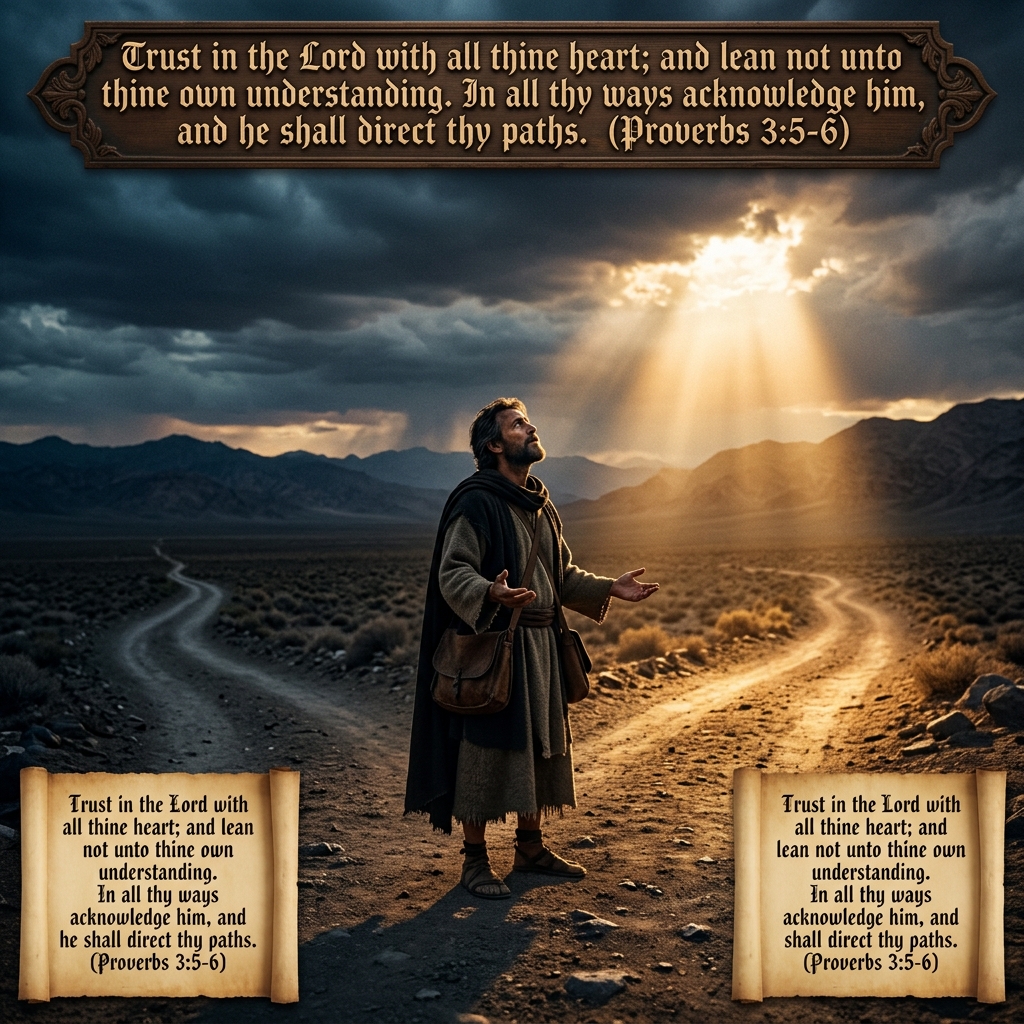
Learning to live on the other side of surrender
I watched a woman at church last Sunday fold her hands tight as the prayer request went around, and I could see her arms shaking just slightly under the sleeves of her coat. She'd been carrying her son's illness for eleven months, and every time someone asked how she was doing, she rehearsed the same faithful answer like a soldier reciting drill. But after service ended, she caught my eye in the parking lot and whispered that for the first time she'd stopped trying to fix what only God could hold. That's the quiet revolution happening inside people who finally learn how to trust in God and let go — it rarely announces itself with trumpets, more often it arrives as a softened jaw, a longer exhale, hands that finally unclench. You'll see it in the way she prays now without bargaining, the way he forgives his brother without keeping score, the way you sit with a silence that used to terrify you.
Rest in Christ rather than fixing yourself, because the gospel is not a set of instructions for self-improvement but a declaration that you are already accepted. You don't have to earn the right to be loved by Him or to believe He's on your side — you receive it like bread at a supper someone prepared specifically for you. The moment you stop performing and start abiding, the pressure lifts off your chest in ways no sermon could ever explain. Let Him love you in the mess instead of loving you only when you've cleaned up, and watch how quickly the fear that's been holding your breath loosens its grip. You were never called to carry this; you were called to rest in the One who does.
Walking in this grace day by day means nothing more mysterious than waking up and choosing, again and again, to trade your excuse for His invitation. It's the small rebellions against anxiety — pausing before you check your bank account out of panic, speaking encouragement instead of criticism to the people in your own house, admitting when you don't have an answer and leaving the silence with God instead of fleeing it. It's learning that trust isn't a single heroic decision but a thousand tiny surrenders stitched together over ordinary weeks. You'll stumble, you'll grip again, and you'll open your hands once more — that's the rhythm of faith, not a straight line. Every time you choose to let go rather than control, you're walking in the very grace that bought your freedom.
For whosoever exalteth himself shall be abased; and he that humbleth himself shall be exalted. — Luke 14:11, KJV
For whosoever exalteth himself shall be abased; and he that humbleth himself shall be exalted.— Luke 14:11, KJV
Standing on what never moves
The baseline is simpler than you've been led to believe: God's promises don't depend on your performance, and nothing in creation can sever what Christ has joined to you. He who did not spare His own Son but delivered Him up for us all, how shall He not with Him freely give us all things? That single question swallows every doubt you've ever whispered in the dark, because a God who gave His best will not withhold what's good from you now. The ground beneath your feet is not your own reliability but His faithfulness, and that's why you can stand when everything else shakes. Every storm will come, yes — but storms reveal the foundation, they don't redesign it.
Beware the old chains of performance creeping back in through the side door of your own good intentions, because religion always promises rest while it quietly reinstates the weight. You'll catch yourself bargaining with God again, offering Him your best behavior in exchange for His blessing, and you must recognize that trade for what it is — a return to slavery disguised as spirituality. The enemy's favorite tactic isn't to make you believe you're too far gone but to convince you that you still have to earn your way back. Don't take the leash of self-effort from a deliverer who already broke it for you, and don't trade the freedom of grace for the exhaustion of trying. Let go completely, because half-surrender is just another form of control.
And thou shalt be blessed; for they cannot recompense thee: for thou shalt be recompensed at the resurrection of the just. — Luke 14:14, KJV
And thou shalt be blessed; for they cannot recompense thee: for thou shalt be recompensed at the resurrection of the just.— Luke 14:14, KJV
So here I am, leaving you with nothing more than an open hand and a quiet invitation: stop clutching what only God can hold, and come to the supper He's already prepared. You don't have to fix yourself before you're welcome, and you never had to earn your place at this table — His blood speaks louder than every excuse you've ever made. When the phone rings in the dark tonight, or tomorrow, or next November, meet it with a breath and a whispered yes instead of panic. Let go of the ground you bought, the oxen you tested, the obligations that stole your obedience — He is enough to hold what you release. And trust me when I say this, because I've lived inside the other side of surrender: you'll find peace there that no performance could manufacture and no fear can steal away.