The clock reads three in the morning. My heart drums against my ribs like a marching band, each beat echoing the words I whispered to myself: "I don't deserve this peace." A cold draft slips through the cracked window, b...
- Midnight Reckoning: Trusting God's Word through life's deepest trials and seasons of waiting.
- The Exhaustion of Self-Justice: Trusting God's Word through life's deepest trials and seasons of waiting.
- Grace in the Everyday: Trusting God's Word through life's deepest trials and seasons of waiting.
Midnight Reckoning
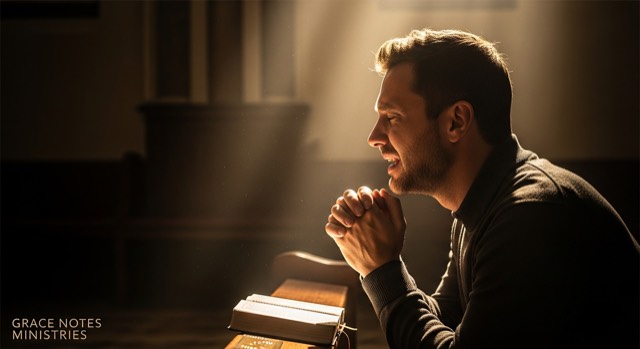
The clock reads three in the morning. My heart drums against my ribs like a marching band, each beat echoing the words I whispered to myself: "I don't deserve this peace." A cold draft slips through the cracked window, brushing my cheek as I stare at the ceiling, replaying yesterday's argument with my spouse. The room feels like a courtroom where I'm both the accused and the judge, and I’m holding a verdict that is too heavy to lift.
Then, my eyes fall on the familiar words of the Lord's Prayer. "And forgive us our debts, as we forgive our debtors," He says, inviting me to lay my guilt at His feet. The same prayer that once seemed like a list of requests becomes a promise—a guarantee that the Father will intervene in my mess. Ephesians 4:32 adds depth to this promise, urging us to be tenderhearted and forgiving, just as Christ forgave us. The truth settles over my heart like a gentle rain, erasing the sharp edges of shame.
The KJV text does more than describe forgiveness; it redeems the brokenness of my night. The verse is not a suggestion but a command that carries divine power. When I repeat those words with earnest faith, the darkness retreats. My debtors are myself and my lover; my debts are the grievances that kept me awake. In that moment, I realize God's forgiveness is not a slow tide but a sudden flood that drowns my guilt.
"And forgive us our debts, as we forgive our debtors."— Matthew 6:12, KJV
The Exhaustion of Self-Justice
I used to think I could earn forgiveness by ticking boxes: attend church, say the right prayers, perform good deeds. The performance ladder felt sturdy until a storm of personal failure knocked it down. My best attempts at perfection left me more exhausted than relieved; the pressure of maintaining a spotless record became an invisible prison.
Christ's finished work shatters that illusion. He took my sins upon Himself, and the penalty is already paid. There is no longer a ladder to climb; there is a door that He has opened wide. The weight of guilt lifts, not because I am stronger, but because His righteousness covers me like a shield. The grace that flows from the cross is instantaneous—once I accept it, the debt vanishes.
Matthew 12:31-32 underscores this truth with urgency. "All manner of sin and blasphemy shall be forgiven unto men," He declares, reminding us that the Father’s mercy has no limit except for the unpardonable sin. This is a reminder that the scope of forgiveness stretches far beyond human comprehension, and it does so in an instant.
"Wherefore I say unto you, All manner of sin and blasphemy shall be forgiven unto men: but the blasphemy against the Holy Ghost shall not be forgiven unto men."— Matthew 12:31, KJV
Grace in the Everyday
A weekday morning rolls out like a rough tapestry. My child spills cereal on the floor, my partner forgets to pick up milk, and my mind is already racing toward the next mistake. The urge to correct everything snaps like a rubber band, but there’s a quiet voice that whispers, "Rest in His grace." I pause, feeling the tug between my effort and God's mercy.
I share with my friends that true rest isn’t found in fixing the broken pieces of our day, but in surrendering them to Him. When I stop trying to patch every flaw, the peace spreads into my heart like sunrise after a long night. It’s not lazy; it’s trusting that His love covers our imperfections without us having to earn it.
Walking in this grace daily requires a mindset shift. I am no longer the manager of my own perfection; I am a recipient of an unending mercy. Each misstep becomes a chance to demonstrate how quickly God wipes the slate clean. The day is no longer a test of endurance but a testimony to His rapid forgiveness.
"And be ye kind one to another, tenderhearted, forgiving one another, even as Christ forgave you."— Ephesians 4:32, KJV
Anchored in the Eternal
The foundation of all this hope rests on the immutable promise found in Matthew 6:13. "For thine is the kingdom, and the power, and the glory, for ever. Amen." This verse assures us that the authority to forgive comes from an eternal throne, unaffected by our temporal failures. The certainty of God's forgiveness is as solid as a mountain that never moves.
A final warning: do not slip back into the chains of performance. The moment we start counting our good deeds, we resurrect the old guilt that Christ has already erased. Let us cling to His promise and reject any notion that we must earn forgiveness. The divine invitation is simple—step into the light of His mercy and stay there.
"For thine is the kingdom, and the power, and the glory, for ever. Amen."— Matthew 6:13, KJV
May the speed of God's forgiveness be your anchor in every storm. Do not hold onto shame, but release it into the hands of a Father who forgives faster than any breath you can take. May your days be marked by the freedom that comes from knowing Christ has already paid for every debt, and may your nights be quiet with the assurance that His mercy never sleeps.