The fourth chapter of First Thessalonians stands as one of the most sublime and comforting passages in the entire New Testament canon. Written by the Apostle Paul from Corinth around 50–51 A.D., this epistle addressed a...
- 2. Verses 1–8: Trusting God's Word through life's deepest trials and seasons of waiting.
- 3. Verses 9–12: Trusting God's Word through life's deepest trials and seasons of waiting.
- 4. Verses 13–18: Trusting God's Word through life's deepest trials and seasons of waiting.
1. Executive Summary & Historical Context
The fourth chapter of First Thessalonians stands as one of the most sublime and comforting passages in the entire New Testament canon. Written by the Apostle Paul from Corinth around 50–51 A.D., this epistle addressed a young, vibrant, yet distressed Gentile congregation in Thessalonica.
The Thessalonian believers were experiencing intense localized persecution. Moreover, several members of their church family had recently died. Troubled by pagan misconceptions and fearing that their deceased loved ones would miss the glorious return of Jesus Christ, the Thessalonians sent queries to Paul. In response, Paul wrote 1 Thessalonians 4 to establish two immortal pillars: the call to daily personal sanctification (verses 1–12) and the triumphant revelation of the resurrection and rapture (verses 13–18).
2. Verses 1–8: Sanctification and Personal Holiness
Paul opens the chapter by urging believers to walk in a manner that continuously pleases Almighty God. In the greco-roman world of Thessalonica—where sexual immorality was normalized and even woven into pagan temple worship—Paul’s command was revolutionary:
The King James Bible translates the Greek word Hagiasmos as "sanctification"—the ongoing, Spirit-enabled process of being set apart from worldly corruption unto divine holiness. Paul emphasizes that holiness is not optional for the believer; it is the explicit, revealed will of God.
3. Verses 9–12: Brotherly Love & Leading a Quiet Life
Moving from personal purity to community harmony, Paul commends the Thessalonians for their genuine Christian love (Philadelphia), yet exhorts them to abound more and more.
Notice Paul's striking instruction: "study to be quiet." In an age of noise and restless ambition, the Christian witness shines brightest through faithful labor, quiet diligence, and honest integrity before the watching world.
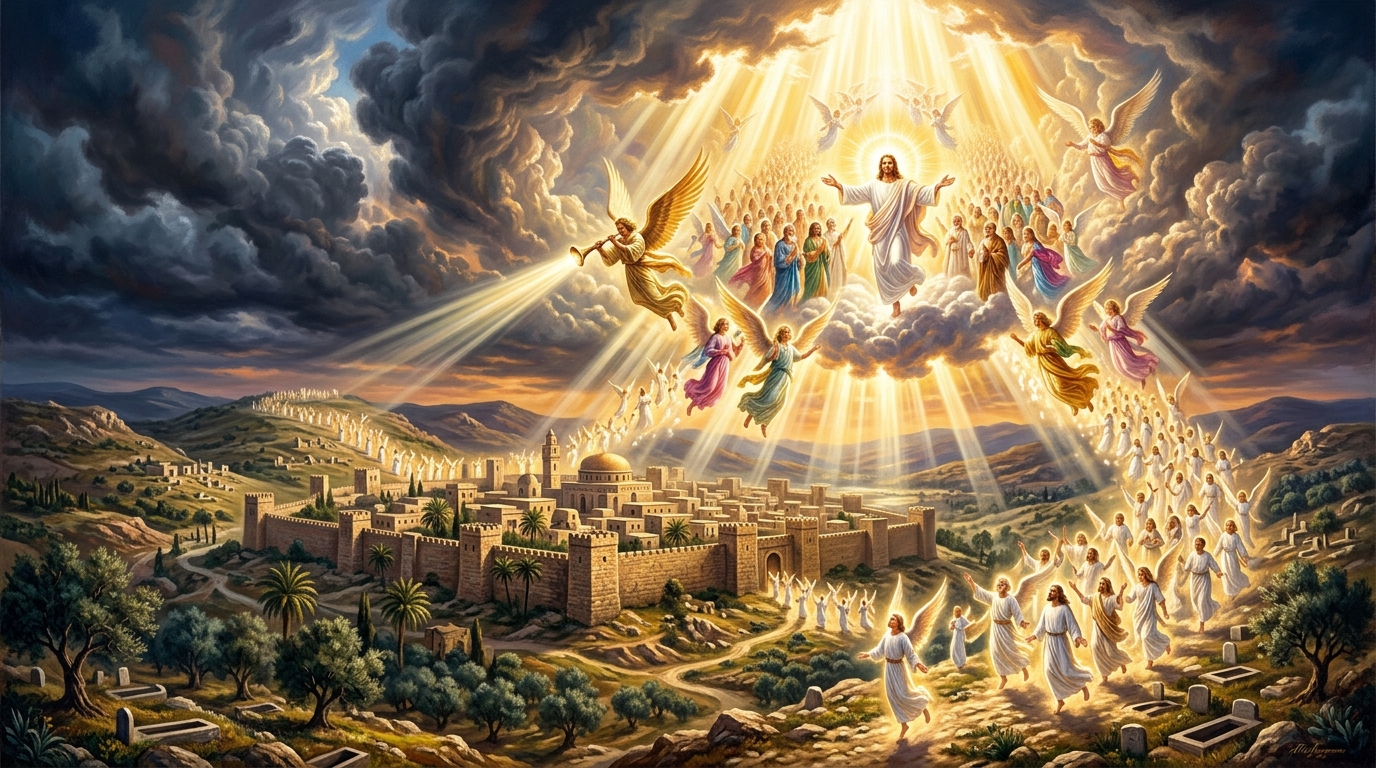
4. Verses 13–18: The Rapture, Archangel's Voice & Blessed Hope
In verse 13, Paul shifts to the primary cause of grief among the Thessalonians: the fate of believers who had died ("fallen asleep"). He delivers the crown jewel of New Testament eschatology:
Key Exegetical Highlights:
- "The Dead in Christ Shall Rise First": Departed believers suffer no disadvantage at Christ's return; their resurrected bodies will be reunited with their spirits prior to the translation of living saints.
- "Caught Up" (Harpazo / Rapiemur): The English word Rapture derives from the Latin Vulgate translation Rapiemur, rendering the Greek Harpazo—meaning to snatch away by force, catch up, or rescue.
- "The Voice of the Archangel & Trump of God": The royal herald signaling the victorious arrival of the King of Kings.
5. Patristic Exposition (Chrysostom, Augustine, Jerome)
"When the King comes into a city, those who are honorable go forth to meet him, while the guilty await their judgment within. So shall the saints be caught up in royal honor to meet their King in the air, while the ungodly await His throne below."
"Paul called death 'sleep' not to suggest soul-sleep, but to assure us of resurrection. As easily as a man awakens from slumber, so easily shall the Almighty Christ raise up the bodies of His saints at the last trumpet."
Related KJV Bible Studies
Continue your study of KJV Scripture with these related exegeses:
- 1 Corinthians 13 KJV Study: Why Charity Never Faileth & Agape Love
- 2 Timothy 4 KJV Study: I Have Fought a Good Fight & The Crown of Righteousness
- The Biblical Doctrine of Salvation (KJV Exegesis)
6. Frequently Asked Questions
7. Academic & Patristic Bibliography
- Chrysostom, John. Homilies on the Epistles of St. Paul to the Thessalonians. Nicene and Post-Nicene Fathers, First Series, Vol. 13. Edited by Philip Schaff. Buffalo, NY: Christian Literature Publishing Co., 1889.
- Augustine of Hippo. De Civitate Dei (The City of God). Translated by Marcus Dods. Edinburgh: T. & T. Clark, 1871.
- Jerome. Epistola CIX ad Minervium et Alexandrum: De Resurrectione Carnis. Patrologia Latina 22: 907-915.
- Bruce, F.F. 1 & 2 Thessalonians. Word Biblical Commentary, Vol. 45. Waco, TX: Word Books, 1982.