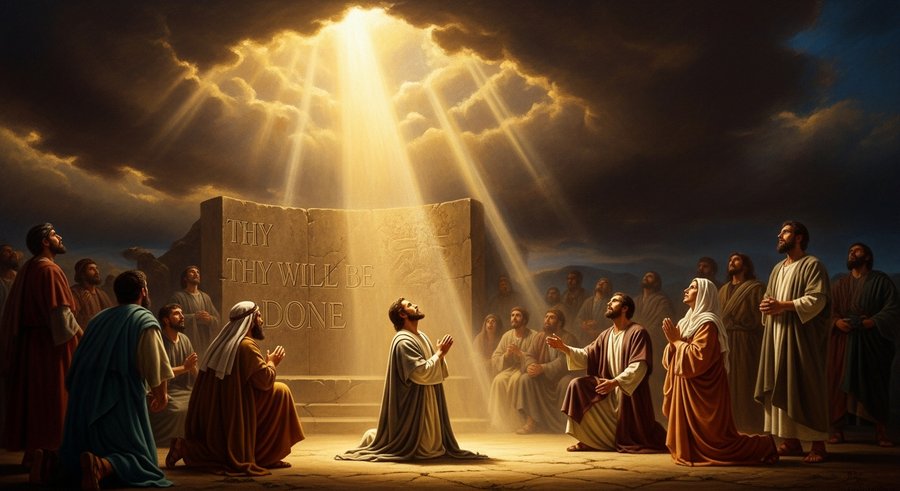
Five words. That is all it was. Five words that our Lord and Saviour Jesus Christ prayed in the darkest garden of His earthly ministry, with the crushing weight of the world’s sin pressing in from every direction. In the shadow of the olive trees of Gethsemane—a name meaning "oil press"—the Son of God was pressed beyond measure, sweating as it were great drops of blood falling down to the ground.
"Thy will be done."
He uttered these words knowing precisely what was coming: the betrayal of a friend, the mockery of a trial, the scourging of His flesh, and the agonizing, wrath-bearing death of the cross. He said it when every human part of His sinless humanity felt the natural shrink from death and separation from the Father. He said it not from a place of stoic resignation or weakness, but from a position of supreme, divine strength—a strength that we, as born-again believers, are called to participate in through our relationship with Him.
Five words. That is all it was. Five words that our Lord and Saviour Jesus Christ prayed in the darkest garden of His earthly ministry, with the crushing weight of the world’s sin pressing in from every direction. In the...
- The Two Wills in Every Life: Trusting God's Word through life's deepest trials and seasons of waiting.
- The Gethsemane Pattern: Trusting God's Word through life's deepest trials and seasons of waiting.
- Surrender Is Not Defeat: Trusting God's Word through life's deepest trials and seasons of waiting.
The Two Wills in Every Life
Every true child of God lives with a daily tension: the operation of two distinct wills. There is our human will—the plans we have carefully built, the life we have meticulously constructed, and the outcomes we are convinced would be best if we could only arrange the circumstances correctly. Then, there is His perfect, sovereign will—which is eternal, deeper than our finite minds can fathom, and rarely conforms to our earthly timelines.
The natural man spends years, sometimes decades, trying to force these two wills into alignment by bending God's will to match his own. We treat prayer as a mechanism to secure God's signature on our pre-written plans. We consult Him on the final drafts of our lives while reserving the right to write the first draft ourselves. We offer Him the leftovers of our planning and mistake this self-directed activity for biblical faith.
"Thy kingdom come. Thy will be done in earth, as it is in heaven." — Matthew 6:10 (KJV)
When we examine the Model Prayer in Matthew 6, we find a profound exegetical truth in the phrase "in earth, as it is in heaven." The Authorized Version precisely translates this as "in earth" rather than "on earth." This is not merely geographical; it is deeply personal. Our physical bodies were formed from the dust of the ground; we are vessels of clay. To pray "Thy will be done in earth" is to ask that God’s sovereign purposes be fully realized within our earthly vessels, just as they are perfectly executed by the heavenly hosts. Jesus did not pray for the Father to rubber-stamp His human preferences. He prayed for absolute alignment, demonstrating that true prayer is not about moving God to our side, but about submitting our hearts to His eternal decree.
The Gethsemane Pattern: The Ultimate Exegesis of Submission
To understand the depth of this surrender, we must look closely at the Greek text reflected in the King James Version's rendering of the Gethsemane account. In the Gospel of Matthew, we witness the progression of Christ's prayer:
"And he went a little further, and fell on his face, and prayed, saying, O my Father, if it be possible, let this cup pass from me: nevertheless not as I will, but as thou wilt." — Matthew 26:39 (KJV)
And again, in the second petition:
"He went away again the second time, and prayed, saying, O my Father, if this cup may not pass away from me, except I drink it, thy will be done." — Matthew 26:42 (KJV)
Notice the shift in the petition. In the first prayer, there is a request concerning the "cup"—the cup of God's righteous wrath against sin—asking if there might be any other way to accomplish redemption. But by the second prayer, the request shifts from asking for the cup to pass, to a complete, restful acquiescence: "thy will be done."
This is the pattern of true spiritual maturity. It is not a legalistic duty performed by a servant who fears a harsh master; it is the loving submission of a Son to His Father. Our salvation is not a cold, religious contract, but a vibrant, born-again relationship with Jesus Christ. Because we have been adopted into the family of God, we do not cry out in terror, but in filial trust, knowing that the Father’s will is always good, acceptable, and perfect.
Surrender Is Not Defeat
In our modern, self-assertive culture, the word "surrender" carries a highly negative connotation. It implies defeat, weakness, and the exhaustion of all viable options. To surrender means you have lost the battle, run out of resources, and must now submit to a hostile force.
But in the economy of God's grace, surrender is the gateway to victory. Yielding our will to His is not an admission of defeat; it is an act of stepping into the only plan that was ever designed to work. When we attempt to run our own lives, we are operating under the delusion that our limited, fallible understanding is superior to the wisdom of the Almighty.
"Neither yield ye your members as instruments of unrighteousness unto sin: but yield yourselves unto God, as those that are alive from the dead, and your members as instruments of righteousness unto God." — Romans 6:13 (KJV)
To yield ourselves unto God is an act of spiritual sanity. Consider the alternative: when we hold tightly to our own will, we are declaring that we believe our knowledge of the future, our understanding of our own hearts, and our capacity to manage the universe is superior to His. This is not strength; it is the most exhausting form of pride. True strength is found in acknowledging our limitations and resting entirely upon the character of Him who "declareth the end from the beginning" (Isaiah 46:10).
The Moment of Letting Go
For many believers, the point of absolute surrender does not occur during moments of quiet contemplation, but in the crucible of affliction. We often reach the end of our own will only when our plans have utterly failed, our resources are depleted, and the structures we built for our own security have crumbled around us. It is in the quiet of the ruins that the voice of the Holy Spirit speaks most clearly to the broken heart.
When we finally look up from the wreckage of our self-will, we find that He has been there all along, waiting to lead us into a life of true spiritual fruitfulness. We stop fighting, we stop negotiating, and we simply say, "Thy will be done."
"Trust in the LORD with all thine heart; and lean not unto thine own understanding. In all thy ways acknowledge him, and he shall direct thy paths." — Proverbs 3:5-6 (KJV)
" The Hebrew verb for "lean" refers to supporting oneself on a staff or a pillar. When we lean on our own understanding, we are trusting in a broken reed that will inevitably pierce our hand. When we acknowledge Him in "all" our ways—not just the spiritual ones, but our careers, our families, our trials, and our triumphs—He promises to make our paths straight.
This is not passive resignation; it is active, dynamic redirection. The moment you stop trying to be the architect of your own destiny and allow the Lord to be the builder, your life ceases to be a series of random, chaotic events and becomes a purposeful, divinely directed journey.
Five Words That Free You
You do not need to have the entire map laid out before you to take the next step of faith. You do not need to comprehend the intricate details of how God is going to work all things together for your good. That is not how biblical trust operates. Faith is not sight; it is resting on the character of the Promise-Maker.
"And we know that all things work together for good to them that love God, to them who are the called according to his purpose." — Romans 8:28 (KJV)
The promise of Romans 8:28 is reserved for those who are "the called according to his purpose"—those who have abandoned their own self-styled purposes to embrace His. When you pray "Thy will be done" and truly mean it, you are released from the crushing burden of trying to control the universe. You are freed from the anxiety of tomorrow, the regret of yesterday, and the pressure of today.
These five words—Thy will be done—have the power to turn a life of striving into a life of deep, abiding peace. It is the simplest prayer a believer can utter, yet it is the most powerful declaration of faith we can make. May we, as those who have been bought with a price, lay down our crowns at His feet and trust Him to write the story of our lives for His ultimate glory.