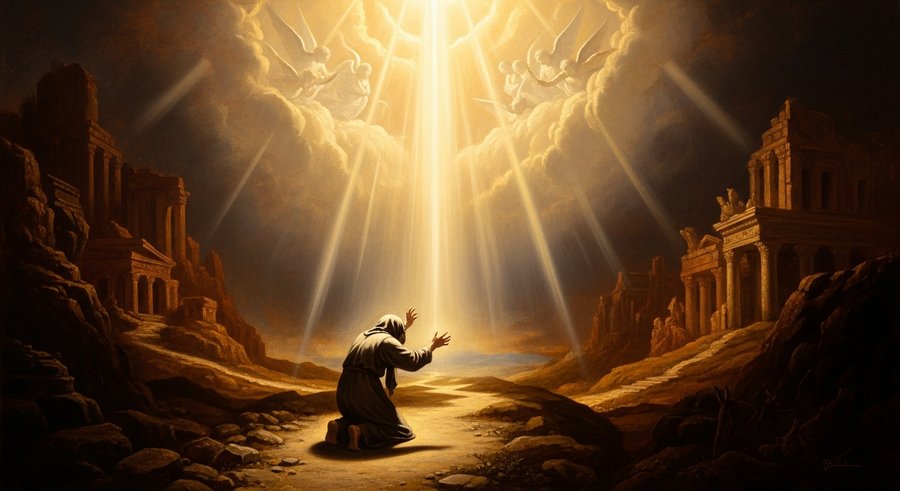
Of all the questions a human being can ask, few carry more weight than this one: How can I be saved? It is a question that rises from somewhere deep — from a moment of loss, a season of searching, a quiet ache that all the noise in life cannot drown out. If you are asking it right now, then hear this first: the fact that you are asking means the door is not only open. It has been waiting for you.
This is not a complicated process. The world has made it complicated. Religion has added requirements, prerequisites, and performance standards that the Bible never placed on the door. Let's look at what Scripture actually says — plainly, without walls around it.
Of all the questions a human being can ask, few carry more weight than this one: How can I be saved? It is a question that rises from somewhere deep — from a moment of loss, a season of searching, a quiet ache that all t...
- What Does It Mean to Be Saved?: Trusting God's Word through life's deepest trials and seasons of waiting.
- What Jesus Did — and Why It Matters: Trusting God's Word through life's deepest trials and seasons of waiting.
- So — How Do You Actually Receive It?: Trusting God's Word through life's deepest trials and seasons of waiting.
What Does It Mean to Be Saved?
To be saved means to be rescued. Specifically, rescued from the spiritual consequence of sin — which is separation from God — and brought into a living relationship with Him through Jesus Christ. It means the debt you owed, the gap between you and God, is forgiven and closed. Not because you earned your way across it, but because Jesus crossed it for you.
The Bible is not subtle about this gap. Romans 3:23 says that "all have sinned and fall short of the glory of God." All. Not most. Not the especially bad ones. Every human being. And Romans 6:23 says the consequence of that falling short is spiritual death. But Paul doesn't stop there — he completes the sentence: "but the gift of God is eternal life in Christ Jesus our Lord." The same verse that carries the bad news carries the best news: there is a gift, and it has already been given.
What Jesus Did — and Why It Matters
Here is the core of Christianity, and why salvation is called a gift rather than an achievement: Jesus Christ, the Son of God, came to earth as a human being. He lived the perfect life no human could live. He then died on the cross — not for anything He had done, but as a substitute for every person who had ever fallen short of God's standard.
He absorbed the full consequence of sin. And three days later, He rose from the dead — proving that the payment was accepted, that death itself had been defeated, and that eternal life was now available to anyone who would receive it.
"But God demonstrates His own love toward us, in that while we were still sinners, Christ died for us."— Romans 5:8 (KJV)
While we were still sinners. Not after we cleaned ourselves up. Not after we became worthy. At our absolute worst, He moved toward us. That is not religion. That is grace.
So — How Do You Actually Receive It?
Romans 10:9 gives the clearest answer in all of Scripture:
"That if you confess with your mouth the Lord Jesus and believe in your heart that God has raised Him from the dead, you will be saved."— Romans 10:9 (KJV)
Two things: confession and belief. That's the door. No checklist of moral improvements. No spiritual resume. No minimum number of church services or charitable acts. You believe — genuinely, in your heart — that Jesus died for you and rose again. And you confess — you acknowledge it, you own it, you trust it. Salvation is not a transaction of religious performance; it is a transaction of trust.
How to Receive Salvation
How do you do this? It's simple. You acknowledge your need (Romans 3:23). You believe in His work (Romans 5:8). And you receive the gift (Romans 6:23).
A Prayer to Receive Salvation
There is no magic formula here. These are not incantation words — they are simply a guide if you don't know where to begin. What matters is that you mean it.
A Simple Prayer of Salvation
Lord Jesus, I believe that You are the Son of God. I believe that You died for my sins and rose again from the dead. I am not coming to You because I have it all together — I am coming to You because I don't, and I know that You do. I receive Your grace. Forgive me. Come into my life. You are my Lord and my Savior. Thank You for the gift I could never earn but You gave anyway. Amen.
Or say this Quick Prayer if you are overwhelmed:
"Lord Jesus, I believe You died for me. I ask for forgiveness and I open my heart to You. Thank You for saving me."
If you prayed that and meant it, something real just happened. Not because of the words, but because of who those words were directed toward — a God who was already watching for you, already running toward you, already waiting for you to turn around.
What Happens After?
Salvation is a beginning, not a destination. What comes after is a life lived in the growing knowledge of who God is and who He says you are. The Bible is His word to you. If you aren't sure where to start, begin with the Gospel of John. Find a community of people who take grace seriously. And remember that the same grace that saved you is the grace that sustains you. You don't graduate from needing it. It is the air you breathe as a follower of Jesus.
Ephesians 2:10 reminds us that we are saved not to be idle but to be purposeful: "For we are His workmanship, created in Christ Jesus for good works, which God prepared beforehand that we should walk in them." The life on the other side of salvation is a life of meaning, belonging, and a love that does not expire — not earned, but walked in.
"For the wages of sin is death, but the gift of God is eternal life in Christ Jesus our Lord."— Romans 6:23 (KJV)
The gift is offered. The door is open. We are praying for you as you step through.